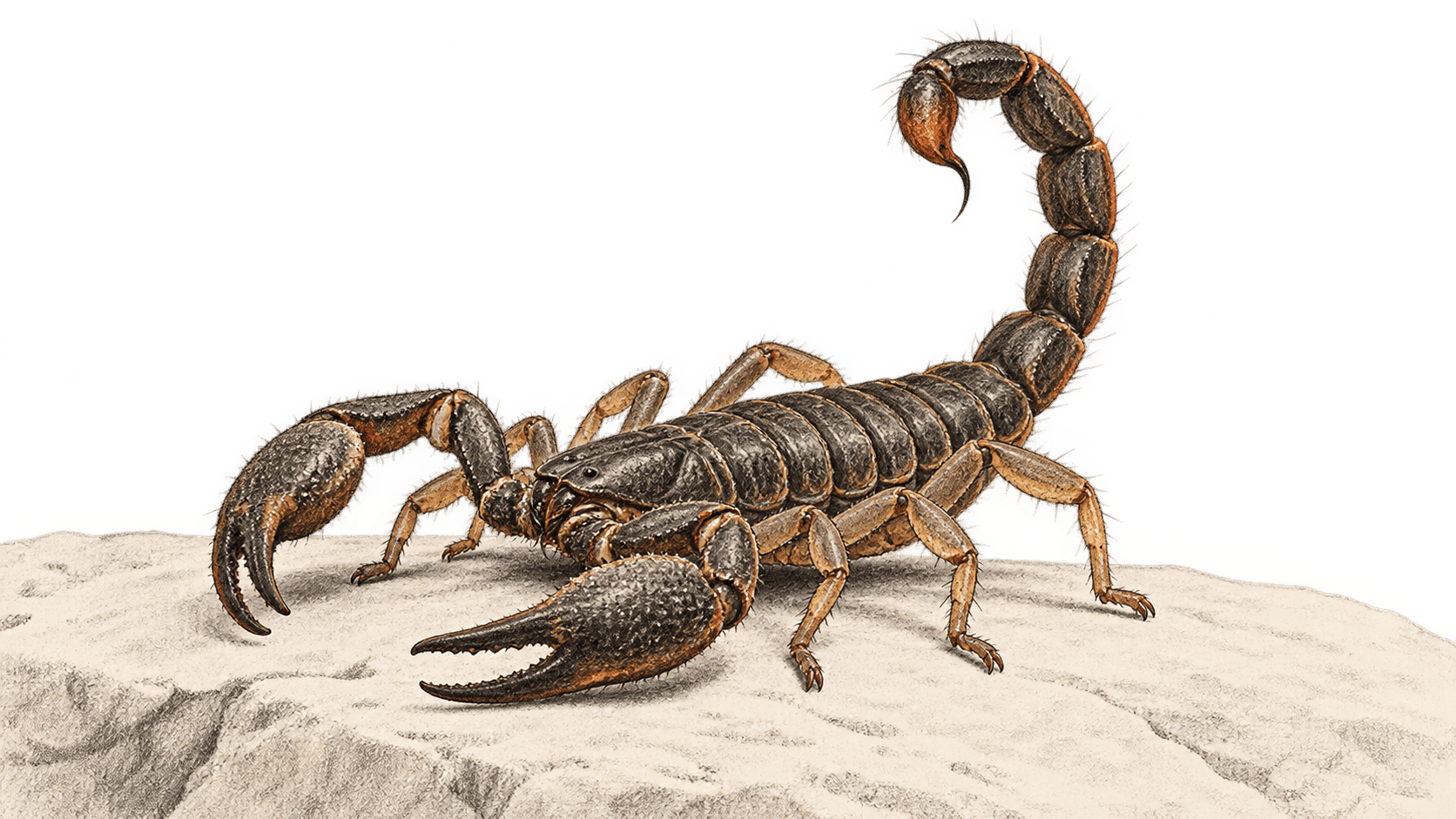
Anthropic says an internal Claude research model generated protein designs aimed at five scorpion neurotoxins. Contract laboratories tested 211 selected designs, and 17 met the researchers’ criteria for binding to an individual toxin. The 20 October 2026 technical report reports a measurable result in toxin-binding protein design. It contains no test showing that any of the new proteins stops a toxin from harming cells or animals.
The big change
- What changed: Anthropic reports that Claude directed much of a protein-design campaign, including computational screening, and that selected designs subsequently bound four scorpion toxins in laboratory assays. That connects an AI-run search to a physical measurement.
- Why it matters: Teams investigating neglected venom targets can inspect the released sequences, predictions and binding traces. The 211 lab-tested proteins were a selected fraction of more than 318,000 computer-generated designs, so the result does not establish a general success rate for AI-generated proteins.
- What to watch: The decisive next experiments are functional tests of whether a binder prevents a toxin’s effect on sodium channels, followed by animal studies. Anthropic reports neither result for these designs; treatment would also require evidence on safety and practical delivery.
What the laboratories measured
Anthropic’s team chose five toxins: Cn2, Ts1, AaH II, AaH I and LqhIII. It asked Claude to design small proteins that would attach to each toxin’s channel-binding region, individually or across multiple toxins. According to the research announcement, the model generated 318,484 candidate designs over a 64-hour campaign with an initial prompt and four human follow-ups. Claude selected 180 for testing; researchers added 31 with its help. The 211 tested designs are therefore a screened set, not a random sample of everything generated.
Adaptyv Bio and Twist Bioscience, working as contract research organisations, produced the selected proteins in different formats and measured binding by surface plasmon resonance. For four toxins, Anthropic counted a design as a binder only when both laboratories found a hit in every replicate, each reported binding affinity met a threshold of 1 micromolar or tighter, Twist’s fitted response stayed within a theoretical maximum, and its tests found no above-background signal against the unrelated human protein CLEC12A. LqhIII was measured only at Adaptyv; its two qualifying designs followed a one-lab version of the rule. The thresholds and final binder label were set by the research team after it saw the assay data, the technical report says.
Seventeen of the 211 passed those criteria: seven for Cn2, four for AaH II, four for AaH I and two for LqhIII. None qualified against Ts1. The result is about 8% of the selected lab-tested designs. Fifteen qualified in both laboratories; the two LqhIII binders were tested at one. Among 60 designs aimed at one toxin apiece, 11 qualified. Anthropic also tested 151 designs intended to cover two or more toxins; none met its criteria for binding more than one.
These distinctions matter because a detectable hit is broader than the report’s binder label. The technical report records 35 design-toxin pairs that produced hits at both labs, but only 15 cleared all four criteria. Fifteen of the other 20 showed above-background binding to CLEC12A. The researchers also checked some designs against ovalbumin, another unrelated protein. Two of the 17 labelled binders, including the strongest Cn2 candidate, registered hits there. Ovalbumin was not part of the formal binder rule. That result calls for further specificity testing; it does not overturn the reported toxin-binding measurements.
Binding leaves the treatment question open
The two tightest Cn2 binders had reported affinities in the single-digit nanomolar range or tighter at both labs. In competition assays, Anthropic found that its Cn2 binders interfered with binding by LR, an antibody fragment previously reported to neutralise Cn2. This suggests an overlapping or nearby binding site. It does not show that the designed proteins block the toxin’s action.
Anthropic tested binding to recombinant toxins grown from their genes, rather than toxin purified from scorpion venom. It did not run cellular neutralisation assays or test whether the designs protect live animals. The report also says the recombinant toxins’ activity was undocumented, positive controls worked at both labs for only Cn2 and AaH I, and the affinity estimates need stronger independent replicate measurements. The team did not measure immunogenicity, serum lifetime, thermal stability or production cost.
For the AI claim, there is another missing comparison. The study did not run experts or a fixed computational pipeline with the same tools and resources alongside Claude. Anthropic reports roughly 10,000 H100 GPU hours for this campaign. Those figures describe its experiment; they do not establish that Claude saved time or money against another design process.
The practical sequence is now explicit. A promising design would need to bind toxin purified from venom, prevent the toxin’s effect on sodium channels in a functional assay, and protect animals under relevant test conditions before researchers could assess it as a treatment candidate. Safety and delivery would remain separate questions. Anthropic has released the 211 designs and associated measurements, including assay results and sensorgrams, so other researchers can examine the reported binding and test what the present work leaves unresolved. That public release is access to the team’s evidence, not independent replication.
The work belongs alongside earlier BIG CHANGE coverage of AI-designed CAR-T binders as a separate therapeutic-protein experiment. The earlier study examined cell activity against a cancer target. Here, the demonstrated result stops at binding to scorpion toxins.
Sources & further reading
- Anthropic’s research announcement, 20 October 2026 describes the Claude-directed campaign and the contract laboratories’ binding results. Anthropic says the designs have not been shown to neutralise venom in cells and are not an antivenom.
- The team’s technical report, 20 October 2026 details design selection, assays, controls and the one-lab LqhIII exception. It reports no functional neutralisation or animal efficacy test, and no matched expert or fixed-pipeline comparison.
- Anthropic’s data release provides the 211 tested designs, predicted structures, binding results and supporting traces under CC BY 4.0. Public data allow scrutiny; they do not establish independent replication.
- BIG CHANGE’s earlier CAR-T binder report covers a separate AI-designed therapeutic-protein experiment that measured cell activity against a cancer target. The scorpion-toxin study reports binding only.