QuEra's August 27 account of an AI-assisted laser-control pilot describes two different outcomes on a dedicated testbed. An AI agent helped develop and test a relocking controller; the resulting standalone script runs without the model. A separate workflow still uses the agent to tune the laser's feedback settings. That division matters more than the headline recovery rate: it shows where the model was useful in engineering the control logic and where QuEra has removed it from routine execution.
QuEra builds neutral-atom quantum computers, whose lasers must hold precise frequencies to control atoms. When a laser loses its frequency lock, its fast feedback loops may be unable to recover it. A particularly awkward failure is a mode hop: the laser can appear stable while sitting at the wrong wavelength. The recovery procedure must move coarse controls far enough to regain the intended mode, restore fine control, and check an absolute wavelength reference before declaring success.
The big change
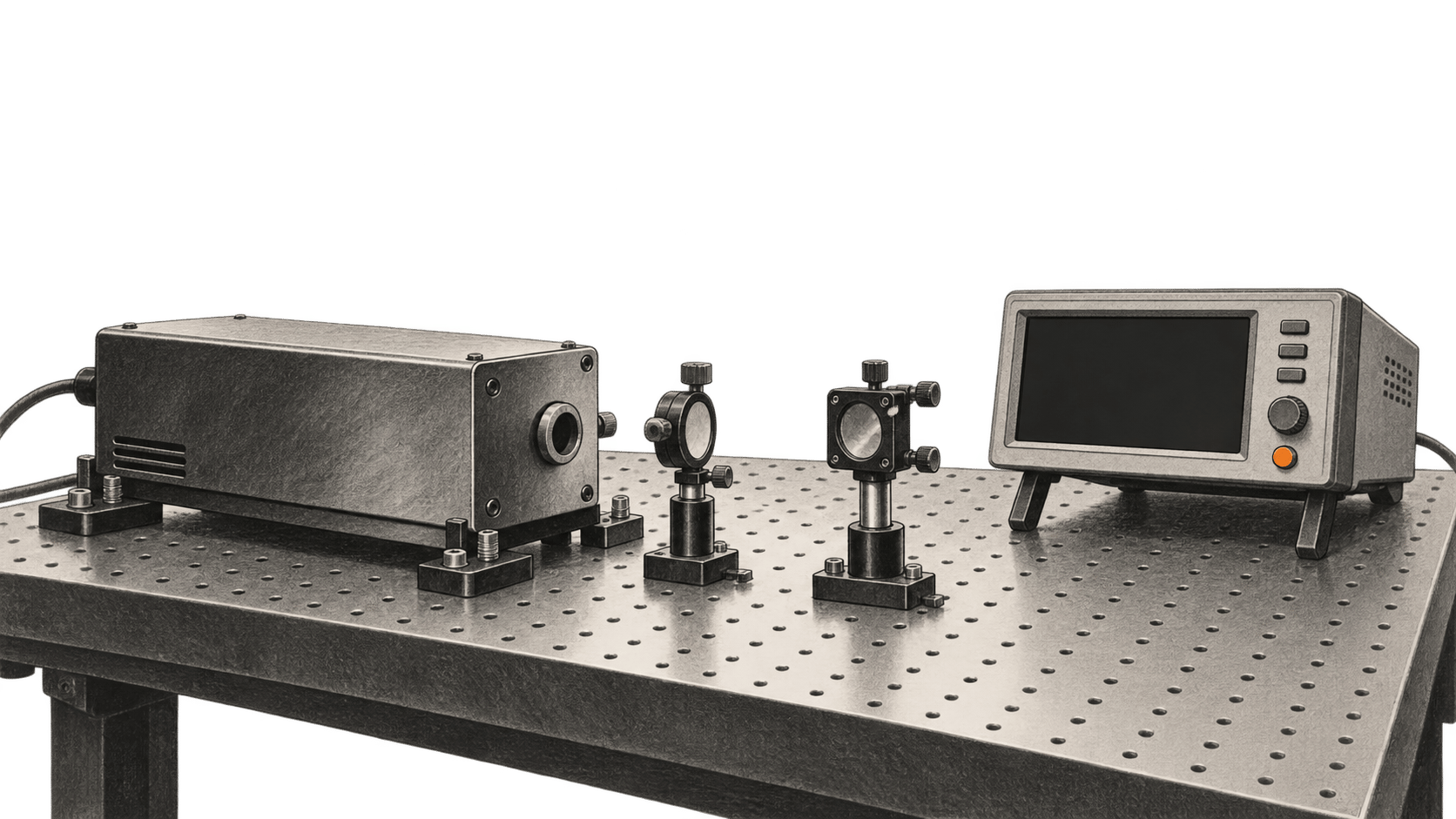
In its August 27 engineering report, QuEra says Claude used Anthropic's Model Hardware Standard (MHS) to experiment on a dedicated laser testbed and develop a fault-specific relocking script. The script reads instrument state, chooses a recovery path and verifies both a cavity lock signal and the target wavelength. QuEra reports that the finished script recovered the correct lock in 695 of 700 timed trials across seven induced disturbance classes. It calls the relocker a standalone production script, with AI out of its runtime loop. The distinct tuning workflow continues to use AI while it searches feedback settings. These are testbed results; QuEra describes deployment on live quantum processors as a next step.
How the control path works
The ordinary fast servo loop remains responsible for holding the laser steady. QuEra describes a stack of controls: a wide-range birefringent filter, a finer etalon and a fast piezo adjustment. The relocking program operates above that fast loop after a disturbance. It receives no label telling it what caused the fault; it reads the instruments, classifies the condition and applies a recovery path. It reports success only when the cavity signal indicates a lock and an absolute wavelength check puts the laser on target. The second check is essential because a stable lock on the wrong mode would be a false recovery.
Claude's role was to develop that program through MHS access to the testbed. Anthropic's August 27 MHS research-preview account describes an iterative development loop in which agent instances proposed changes, wrote code, ran it on the laser and examined logs. Humans set the scope and safety bounds and reviewed the work. MHS exposes device reads and writes through drivers and enforces device-declared limits, interlocks and emergency stops at the hardware interface, according to the two companies. The model is not sitting inside the microsecond servo loop, and QuEra says the finished relocker no longer calls on the model at runtime.
That sequence produced different numbers at different stages. Anthropic reports about six-second recovery and 96% success during an overnight development run; its 99.3% figure comes from the later test of the finished script, with no agent involved. QuEra specifies 100 timed trials in each of seven disturbance classes: 695 on-target recoveries out of 700. It reports 0.9–5.4 seconds for faults that preserved wavelength and about 10–14 seconds for the hardest mode hops, compared with its estimate of five to ten minutes for a human specialist. QuEra says the five misses shared a rig-condition cause and that the controller did not incorrectly declare them successful. Over weeks of the pilot, it also reports automatic recovery from all 43 spontaneous mode hops on that testbed. None of those counts establishes reliability across other lasers or operating sites.
Tuning still has an agent in the loop
Relocking after failure is only one problem. QuEra also used the agent to search 12 interdependent feedback parameters that affect residual frequency noise. It says the tuning workflow assessed the full noise spectrum after adjustments, reverted settings that dropped the lock and kept candidate changes inside a safety envelope. QuEra reports no mode hop during roughly 12,500 evaluations. It reports a fivefold reduction in residual frequency noise and no unattended lock drop in an approximately 19-hour soak test, versus 1.6 drops per hour before. These figures are QuEra's measurements under the pilot conditions, not a field reliability rate.
For a comparison outside the optimization loop, QuEra says an instrument the agent could not control measured the resulting noise against a specialist's manual tune. The two were similar across the measured band except near a 220 kHz resonance, where QuEra reports roughly a thousandfold less noise with the agent-selected settings. Its linewidth-type measure moved from 58 to 21 kHz. Anthropic's account supplies a different tuning measure from a described campaign: residual error fell from 15.7 to 1.55 mV over 363 experiments and 16 unattended hours. Those figures should not be read as a second measure of the relocker's 700-trial success rate or merged into one universal improvement factor.
QuEra says the agent then tuned a second operating wavelength in an unattended overnight run, leaving that lock roughly ten times quieter than it found it. The company has not described this AI-in-loop tuning process as a packaged standalone tool. It says packaging that workflow is future work.
What the pilot establishes
The August reports give unusually concrete test conditions for a company account: a dedicated testbed, induced faults in seven classes, an on-target verification rule, spontaneous events during the pilot, and separate tuning checks. They also set a firm limit. The public accounts do not provide the complete script, per-trial logs or a reproducibility package with which an outside lab could repeat the reported rates. BIG CHANGE did not test the hardware. Anthropic's account is a second company description of the QuEra collaboration, not an independent replication.
MHS itself was announced on August 27 as a research preview for an initial group of labs and manufacturers. Anthropic invited applications and said it planned to make the standard open source later. QuEra's use of the preview on a dedicated rig does not make MHS generally available, nor does a script QuEra calls “production” show that this particular controller is already operating across its commercial machines. The practical result for laser and quantum-hardware engineers is narrower and still useful: an agent explored and tested recovery logic against a physical system, while the running relocker now follows inspectable deterministic logic with explicit verification. The tuning loop remains an active AI experiment with a different deployment boundary.
Sources & further reading
- QuEra, “Holding the Light: Teaching an AI to Lock and Tune our Quantum Computer’s Lasers” (August 27, 2026). QuEra's engineering account supplies the testbed setup, seven-class relock validation, spontaneous-hop count, tuning measurements and the distinction between the standalone relock script and AI-in-loop tuning. Its results are company-reported.
- Anthropic, “Previewing the Model Hardware Standard” (August 27, 2026). This explains MHS's driver and safety interface, research-preview access and the QuEra development loop. Its QuEra section is a partner account, not an independent hardware replication.