On November 24, NVIDIA published supervised real-robot footage of Microduck avoiding obstacles, extending its simulation work.
The big change
- Microduck keeps its walking policy weights fixed while a separate controller adjusts the operator’s movement request. The hardware demonstration includes human steering intervention.
- A small distance sensor supplies measurements across separate viewing zones. Its manufacturer’s tests show why lighting and target surfaces change the range recorded under specified conditions.
- A visible successful maneuver does not establish a dependable completion rate. Repeatable trials need defined conditions, recorded failures and a clear account of the operator’s contribution.
What the hardware result adds
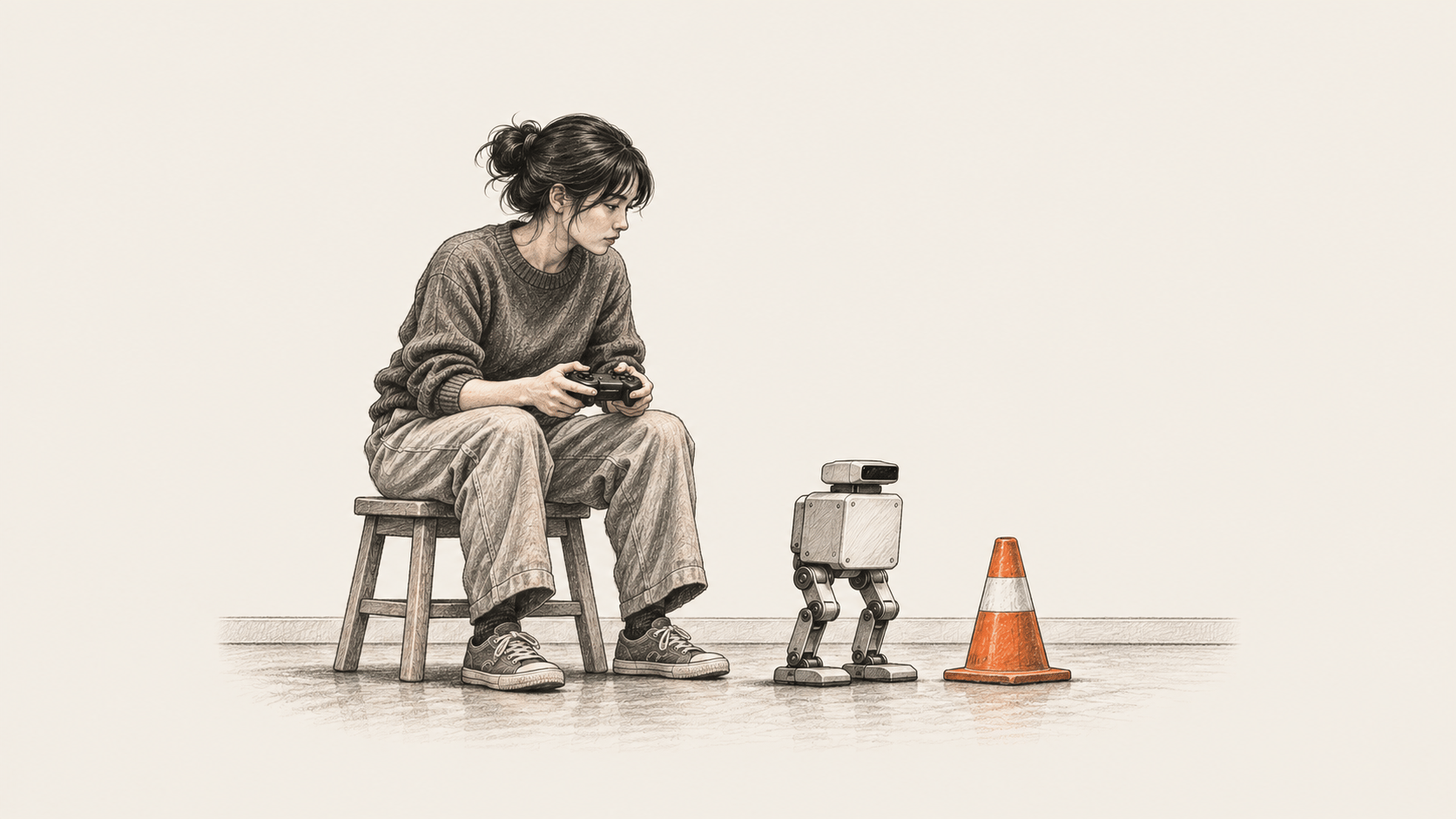
NVIDIA’s Figure 4 pairs real cone-course footage with a reconstruction from robot logs. The caption distinguishes policy steering in blue from operator intervention in purple. It is a supervised demonstration, without a physical-course success rate.
The avoidance model runs on a laptop and modifies gamepad commands before they reach the robot’s walker. Its input includes an 8×8 VL53L5CX time-of-flight sensor. It adjusts forward, sideways and turning commands; the fixed walker translates these into joint movements.
Training varies simulated layouts and adds sensor noise, delays and missing readings, so the controller encounters imperfect inputs before hardware testing.
Distance readings have conditions
Time-of-flight sensing measures distance using emitted light and its return. STMicroelectronics’ VL53L5CX documentation describes separate ranging zones: an 8×8 output contains 64 zones. That is a sparse distance grid, rather than a detailed color picture of everything ahead.
The datasheet gives a useful conditional example. In continuous 8×8 operation at 15 measurements per second, its inner zones have a typical maximum range of 3.5 metres for an 88%-reflectance white target in darkness. Under the specified illumination equivalent to 5,000 lux daylight, that becomes 1.1 metres.
These tests use a target filling the field of view, without cover glass, and base maximum range on a 90% valid-detection rate. They are sensor characterization, not a robot stopping-distance measurement. A component’s headline range therefore cannot stand in for what a moving machine will consistently detect in another environment.
The motors must match the simulation too
Separate actuator research explains another part of the simulation-to-hardware problem. A servo is a motor system that tries to reach a commanded position. Friction can prevent movement from starting, then change as the joint moves or the load changes. A simulated joint can therefore react differently even when it receives the same command.
The original Better Actuator Models study fits friction parameters to recorded pendulum movements. It identifies four servos, reserving a quarter of the logs for validation, then compares simulated and measured paths on two arms with two rotating joints each. The authors report improved trajectory agreement over a simpler friction model under those tests.
The study does not model every physical effect: temperature, radial forces and how long contacting surfaces remain stationary are omitted. Its contribution is a way to measure and reduce a specific mismatch. It does not eliminate the need to compare a new robot’s measured behavior with its simulation.
From a demonstration to a repeatable result
NIST’s ground-robot evaluation work separates a test apparatus, an operator procedure, a quantitative metric and a fault condition. One example metric is completing ten continuous repetitions; elapsed time can then turn completion into a rate. Failures are recorded rather than disappearing from the result.
Those methods were developed for response robots, not as a Microduck certification. Their useful general lesson is that a test needs a stable definition before results can be compared across sites or dates. Changing the course or the operator’s role changes what a score means.
For a developer assessing a demonstration, the next useful evidence is therefore a repeatable task description and a record of attempts, timing and faults. That makes it possible to judge whether a result is consistent under the stated conditions, rather than treating a selected maneuver as a general capability.