Union Alpha is no longer an anonymous free model. OpenRouter now identifies the September 16 stealth release as Pareto, a paid composite model from Unbiased. The old stealth/union-alpha listing has ended; the live OpenRouter model is unbiased/pareto.
To use Pareto today, you need its current model ID and prices. Its paid service also needs to be distinguished from the earlier free preview when assessing performance claims.
The big change
- What changed: Union Alpha has emerged as a paid service that runs several underlying models for one request and returns a synthesized answer. Pareto’s operator can change that mix while keeping one public model name.
- Why it matters: Developers gain one endpoint and one bill, but model identity, latency, data handling and output quality depend on the composite service rather than a fixed checkpoint.
- What to watch: Union Alpha’s free preview became a paid product within days. Evaluate the live model ID and current terms, since a stealth listing, launch chart or video test may describe an earlier service state.
Set up Pareto in OpenCode through OpenRouter
You can use Pareto in OpenCode by connecting an OpenRouter account. OpenRouter’s Pareto listing specifies a 262,144-token context window, text and image input, and text output.
- Install OpenCode. In a Bash terminal, use the commands below; Windows users can follow the linked installation options.
- Create an OpenRouter account and API key, then add credits under OpenRouter’s current billing terms. The free Union Alpha period is over.
- In OpenCode, run
/connect, choose OpenRouter, and paste the key when prompted. OpenCode stores provider credentials in its local auth file. - Run
/modelsand selectunbiased/pareto. The formerstealth/union-alphaID is historical. - Ask it to explain a file before requesting edits. Review its explanation against the code, then approve a small change, inspect the diff and run the project's tests. Check OpenRouter's activity record for token use and cost.
curl -fsSL https://opencode.ai/install | bash
cd /path/to/your/project
opencode
If Pareto is missing from the picker, add it to your project's opencode.json, then restart OpenCode:
{"model":"openrouter/unbiased/pareto","provider":{"openrouter":{"models":{"unbiased/pareto":{}}}}}
The openrouter/ prefix belongs in OpenCode's configured model name. OpenRouter's own API uses unbiased/pareto. This setup follows current documentation; we did not run a paid completion for this guide.
Connect directly to Unbiased
Unbiased also offers Pareto through its own reviewed private beta. Its official setup file says new accounts are approved by hand and use prepaid credits. The public API base is https://api.unbiased.ai/v1; the model string is pareto. Direct evaluation access does not by itself authorize commercial or production use, which requires a separate written agreement.
After approval and key issuance, an OpenAI-compatible client can use these settings:
export UNBIASED_API_KEY="your-key-from-the-platform"
curl https://api.unbiased.ai/v1/chat/completions -H "Authorization: Bearer $UNBIASED_API_KEY" -H "Content-Type: application/json" -d '{"model":"pareto","messages":[{"role":"user","content":"Reply with one sentence."}]}'
Keep the key in an environment variable or operating-system keychain, not in a repository. The documentation says GET /v1/models currently returns 404, so clients that insist on model discovery need pareto configured explicitly. Unbiased also publishes a macOS installer, but the endpoint settings above work with any compatible client.
Who built Union Alpha
OpenRouter’s archived listing says Union Alpha was developed and operated by Unbiased and revealed as Pareto. OpenRouter routed the preview; it was not the developer or provider.
Unbiased is the product platform of Circuit & Chisel, Inc. The company names Louis Amira as co-founder and CEO and David Noël-Romas as co-founder and CTO, and says both founders came from Stripe.
Pareto is described as a blended model. Multiple language models run in parallel and their results are synthesized into one response. The company discloses a mix of frontier and open models, but it does not publish a fixed member list. Its terms allow the underlying composition to change without notice when functionality is not materially reduced. The listed inference subprocessors include Anthropic, OpenAI and xAI; that list identifies data processors, not the exact models used on every request.
Current prices and published scores
Pareto’s current uncached-input and output rates are lower than the two frontier comparators selected from Unbiased’s score table. These are API rates in US dollars per million tokens; subscriptions and included allowances are separate. The comparison uses Anthropic’s Fable 5.1 rates and OpenAI’s GPT-6 Astra Standard rates for prompts of up to 272,000 input tokens.
Model | Input | Cached input | Output |
|---|---|---|---|
Pareto 26.9 | $2.50 | $0.25 | $7.50 |
Claude Fable 5.1 | $10.00 | $0.25 | $50.00 |
GPT-6 Astra | $10.00 | $1.00 | $50.00 |
Unbiased’s public pricing page also advertises $10 and $100 personal subscriptions with included usage, while its FAQ describes current access as reviewed, prepaid pay-as-you-go. The platform is therefore the place to confirm which plan is actually offered to a new account.
The Pareto 26.9 model card publishes these seller-reported scores without task costs or effort settings for this slate.
Benchmark | Pareto 26.9 | Fable 5.1 | GPT-6 Astra |
|---|---|---|---|
DeepSWE | 74 | 67 | 74 |
Terminal-Bench 4.0 | 51 | 56 | 58 |
MMMU-Pro | 78 | 81 | 87 |
HLE, no tools | 49 | 55 | 54 |
ArXivMath | 88 | 72 | 91 |
Pareto ties Astra on DeepSWE and trails it elsewhere. It leads Fable on DeepSWE and ArXivMath. Fable leads HLE; Astra leads the remaining rows or ties.
Separately, the card reports a preliminary 30-task DeepSWE slice transcribed from a September 21 screenshot:
Reported run | Score | Mean cost per task |
|---|---|---|
Pareto 26.9, September 20 | 70% | $0.29 |
Claude Fable 5, August 15 | 70% | $13.50 |
GPT-5.6 Sol, August 15 | 60% | $0.52 |
The page calls these runs unvalidated, with cost methodology and denominators still needing confirmation. The comparators are historical. The slice’s $0.29 belongs with its 70% result, never the headline 74.
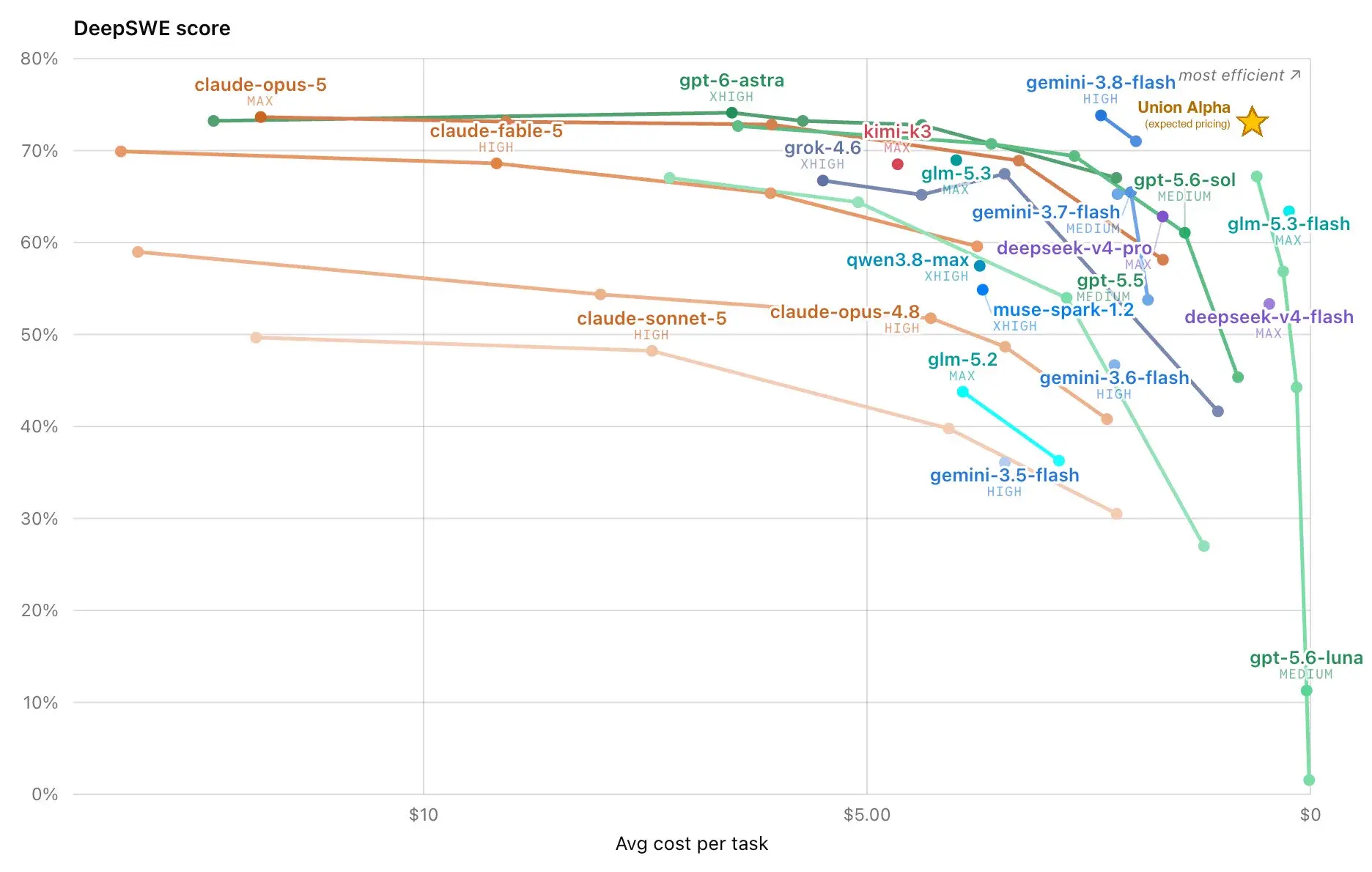
What the original DeepSWE graph shows
The graph shown one minute into Chase AI’s September 17 Union Alpha video came from OpenRouter co-founder Alex Atallah’s September 16 post. It places a gold Union Alpha star at roughly 73% on DeepSWE, among frontier-model results. The star is labeled “expected pricing,” with no exact cost or score printed beside it. The horizontal axis is reversed: its labeled ticks descend from $10 through $5 to $0 toward the right.
Open the original 1872 by 1190 chart if the labels are too small on a phone. This September 16 snapshot records the free preview’s launch positioning. It does not measure today’s paid Pareto 26.9 task cost, and it is separate from the current model-card results above.
What Chase AI’s preview tests show
Chase AI’s September 17 video, “Union Alpha Is INSANE”, records tests of the free preview. The creator preferred Opus 5 on a simple hotel landing page and gave Astra a slight edge on a more detailed page. Union Alpha repeatedly failed a Fortnite-style game task, then completed a simpler racing game after a session restart; the creator judged that result similar to Astra’s.
The motion-design test depended on an external skill and MCP server, so it tested a larger tool chain. The creator also reported 100% on a 128K eight-needle retrieval test and 99.6% on his modified 200K version. We did not rerun those prompts, inspect their graders or test whether Pareto 26.9 behaves the same way.
Check the data terms before sending private code
Circuit & Chisel’s terms say customer content is retained only as needed to process requests, with exceptions for legal requirements and up to 30 days for abuse prevention or security monitoring. Training requires explicit written consent. The Pareto-specific data policy on the same page says its raw prompt-and-response retention window is unpublished and a member-specific commitment will be disclosed before onboarding.
That mismatch deserves a written answer before a team sends sensitive source code. Pareto requests can pass through Circuit & Chisel infrastructure and disclosed model-inference subprocessors. Start with material that is safe to share, then obtain the retention and production-use terms that apply to the account.