A customer changes the address on an order. The message also asks for a refund, mentions a damaged package and hints that this is the third time something has gone wrong. Turning that message into a useful answer is one job. Deciding which records to update, which team should intervene and which actions require permission is another.
Jev, the model TypeSafe AI introduced in early access on September 15, 2026, targets those decisions. It produces constrained, structured answers for software. The launch is an invitation to reconsider how much of an application should depend on a long conversation with a general-purpose model. TypeSafe’s launch announcement
The argument gets its fullest airing in Latent Space’s September 21 interview with TypeSafe co-founder and CEO Diogo Almeida, hosted by swyx. We reviewed the complete English captions of the two-hour, 22-minute conversation and checked the product’s documentation. This is analysis of that interview and the public evidence; we have not independently benchmarked Jev. Watch the original interview
Our reading is that Jev’s most consequential proposition concerns the unit of automation. A company may be able to automate a bounded judgment inside an existing process before it can responsibly hand over the whole process. If the judgment becomes cheap enough to repeat and clear enough to measure, familiar business software could acquire useful capabilities without every interaction becoming a chat session.
That would affect the people designing workflows as much as the people using them. Someone still has to decide which actions are permitted, what counts as an error and who deals with the exceptions. The quality of those decisions will determine whether this approach creates dependable services or just accelerates mistakes.
What TypeSafe has actually launched
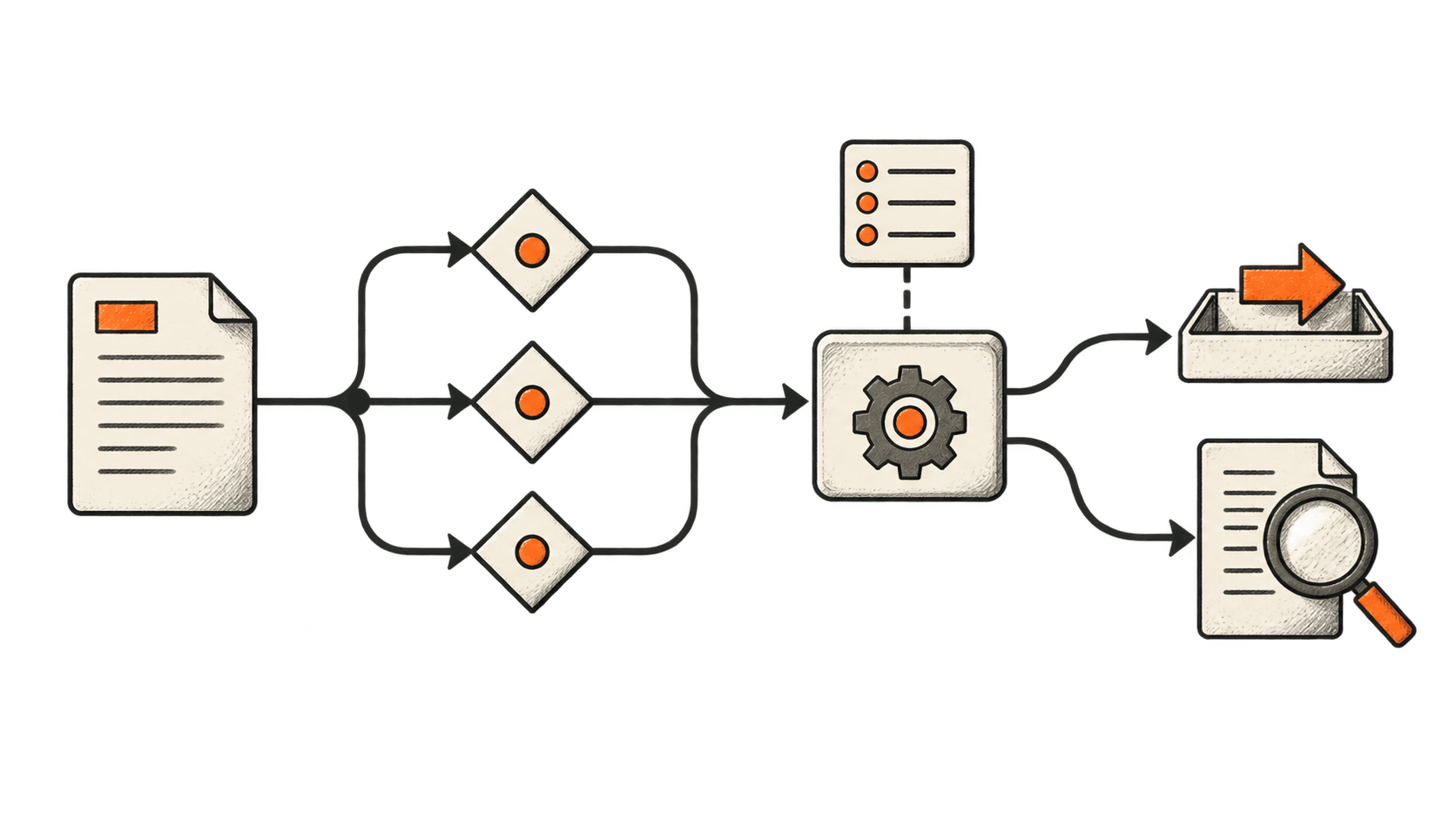
Jev’s documented interface takes a state and a set of typed questions. Its three primitives are Choice, which selects among specified options; Score, which evaluates against a rubric; and Noul, which expresses a statement’s probability on a zero-to-one scale. Choice and Score return distributions and a confidence field. Noul does not have that separate confidence field. Questions can share the supplied state while being evaluated independently. TypeSafe’s interface documentation
In a customer-service application, a developer could use those primitives to distinguish an address-change request from a cancellation, assess urgency and check whether a message contains evidence of damage. These are hypothetical examples, not results from a Jev deployment. The application would then decide what to do with the answers.
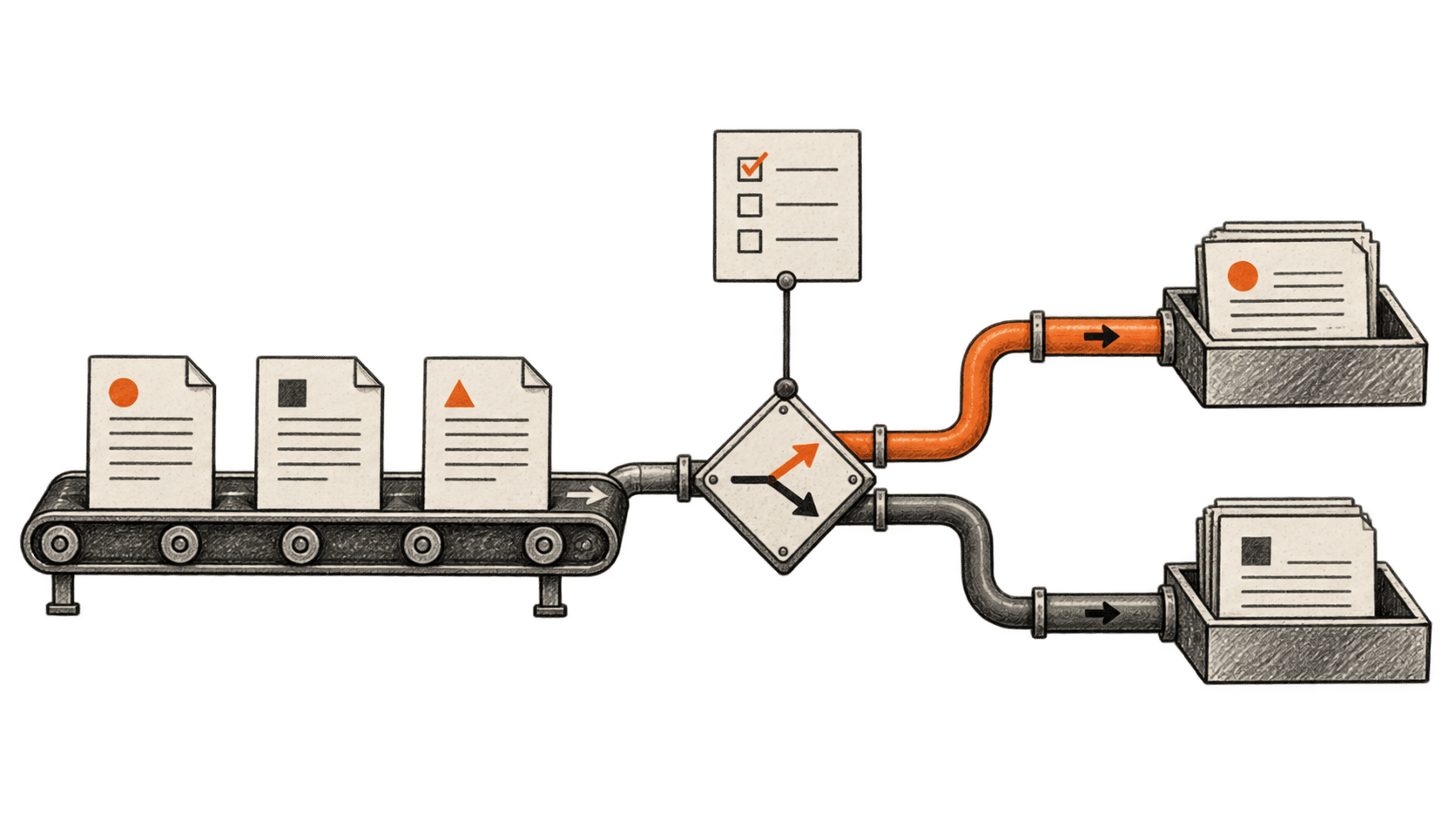
That division is useful because interpretation and authority are different responsibilities. An AI may infer that a customer wants a refund. It should not acquire permission to issue one merely by reaching that conclusion. The application can check the order, enforce a refund limit and require approval where appropriate.
TypeSafe calls this model category System One, borrowing the language of fast, intuitive thinking. Treat the name as a description of the intended workload. It does not certify humanlike cognition or establish a clean boundary between easy and difficult tasks. A short question can conceal a complicated judgment, particularly when the necessary information is missing.
The engineering change is smaller, inspectable decisions
Almeida advocates decomposition: ask narrowly scoped questions, then combine the answers in code. Interview, 1:03:02
Consider the damaged-order example again. A single instruction to handle the complaint hides several judgments inside one response. A more inspectable design would separately establish the requested action, whether the order can be identified and whether the available evidence supports a damage claim. It would keep policy rules outside those judgments.
This makes a failure easier to investigate. If the system routes an address change to the returns team, the operator can examine the routing decision. If the damage assessment is wrong, that component can be tested against previous cases. A policy change can alter an explicit rule without requiring the team to rewrite a broad instruction and hope the model interprets it consistently.
There are costs. More components mean more interfaces to maintain. Questions can accidentally omit context that makes the answer clear. Two apparently independent judgments may depend on the same misleading evidence. A workflow assembled from individually acceptable parts can still produce an unacceptable result.
TypeSafe’s documented patterns include asking several questions together, combining scores and routing uncertain cases for additional handling. They describe architectural options, not proof that a particular customer process is ready for unattended operation. TypeSafe’s patterns
The useful test is whether decomposition improves both diagnosis and outcomes. Being able to explain which step failed is valuable. Reducing the frequency and consequence of those failures is the business case.
A valid answer can still be wrong
The launch’s claim that Jev “can’t hallucinate” requires a narrow reading. TypeSafe ties its guarantee to matching the permitted output schema. That does not establish the truth of a selected answer. Its own announcement distinguishes schema guarantees from empirical evaluation. TypeSafe’s explanation of type safety
Suppose an application allows the values damaged, late and other. Returning damaged is perfectly valid even when the package was merely late. A model that cannot invent a fourth category can still choose the wrong one. If the list excludes a genuinely necessary category, the schema itself becomes part of the problem.
Structured output is also an existing engineering approach. OpenAI introduced schema-constrained Structured Outputs in August 2024 and explicitly noted that a model could still make mistakes within the returned values. Jev therefore needs to be assessed on its particular combination of decision quality, uncertainty reporting, latency and cost, rather than credited with inventing all structured AI output. OpenAI’s original announcement and limitations
For buyers, this distinction changes the evaluation plan. A schema test asks whether software can consume an answer. A factual test asks whether the answer agrees with the evidence. A policy test asks whether the resulting action is allowed. Passing one does not substitute for passing the others.
The interview’s most important challenge concerns calibration
At 1:09, Almeida rejects a suggestion of perfect calibration and acknowledges model errors. Interview, 1:08:50
Calibration concerns how predicted probabilities compare with observed outcomes across groups of predictions. A model can be useful at signaling uncertainty without being correct on every high-probability case. TypeSafe’s primer explicitly preserves that distinction. TypeSafe’s calibration explanation
The API’s confidence field needs a second distinction. TypeSafe describes it as a statistic derived from the answer distribution. It is not interchangeable with an independently measured probability that the selected answer is correct. Its documentation recommends choosing thresholds for the task and its consequences. TypeSafe’s confidence documentation
These are practical concerns. Imagine that a routing model performs well on short English messages but struggles with long complaints that mix several requests. A single aggregate score can conceal that weakness. A high-confidence decision from the weaker group may deserve more scrutiny than the same displayed number from the familiar group.
A team should therefore evaluate the cases it expects to receive, including missing information, unfamiliar wording and deliberately confusing inputs. It should inspect errors by category and compare the cost of sending a case to review with the cost of acting incorrectly. Thresholds become operational choices supported by evidence, rather than numbers copied from a demo.
Calibration research long predates Jev. A widely cited 2017 paper by Chuan Guo and colleagues examined poor calibration in modern neural networks and methods for improving it. That work supplies context for the problem; it does not validate TypeSafe’s model. On Calibration of Modern Neural Networks
Reliability includes what happens when the service changes
The conversation distinguishes robustness from determinism and discusses version stability without a general long-term-support promise. Interview, 41:24 and 49:40
These are separate purchasing questions. Determinism asks whether identical inputs produce identical outputs. Robustness asks whether an irrelevant change, such as a different record identifier, causes an unreasonable change in behavior. A model could repeat the same wrong answer indefinitely and be deterministic. It could also fluctuate slightly while a surrounding workflow remains dependable.
Neither property resolves lifecycle risk. A business needs to know which model revision produced a decision, whether that revision will remain available and how a replacement will be evaluated. An improvement on the provider’s tests can still change the behavior of a customer’s carefully tuned workflow.
The sensible response is to preserve representative cases, record versions and compare replacements before migrating consequential work. A fallback matters too: an otherwise accurate decision service can become unavailable. If the application has no safe way to pause or route work elsewhere, uptime becomes part of its decision quality in practice.
This is where an attractive API turns into an operational dependency. Procurement, monitoring and migration planning do not disappear when the model gets faster. They become easier to neglect because the individual call looks so simple.
Why the speed and price numbers need context
TypeSafe’s headline workflow results include 193.6-fold speed and 444.6-fold cost improvements. The announcement identifies those as high-end gains from company-authored workflows. Reference answers came from other models’ probability estimates, rather than independently verified ground-truth classifications. The company also cautions that its short demonstration favors Jev and that sustainable long-term pricing remains to be established. TypeSafe’s evaluation qualifications
Those qualifications should travel with the numbers. Agreement with a reference model can be informative, but it measures something different from correctness against a resolved customer case. A vendor-designed workflow may be relevant to a buyer without representing that buyer’s distribution of requests.
The right comparison should include the whole job: gathering context, making decisions, applying rules, handling exceptions and recovering from failure. A cheaper model call can coexist with higher total cost if it sends too much work to reviewers. A slower call can be economical if it avoids expensive rework.
Latency also needs to be measured from the application’s actual region. A demonstration close to a service’s infrastructure is not a promise about the experience of a user elsewhere. Interactive systems should inspect slow requests as well as the average; background processing may care more about throughput and total cost.
Jev’s name invokes the idea that efficiency can expand consumption. For an individual business, that raises a budgeting question: which new decisions become worth evaluating, and which merely become cheap enough to evaluate unnecessarily? More model calls are not themselves an outcome.
A different research objective, with unfinished evidence
Almeida’s research argument connects data, task selection and RLCD with his criticism of preference optimization. Interview, 7:23 and 22:12
RLCD stands for Reinforcement Learning for Calibrated Decisions. TypeSafe presents it as training toward usable decisions and probabilities, contrasted with human-preference and verifiable-reward approaches. That is the company’s account of its objective. It should not be mistaken for independent verification of the complete training method. TypeSafe’s AI primer
The broader question is worth pursuing even while the method is evaluated: what behavior does a training objective reward? A model optimized for a persuasive explanation may be pleasant to use without exposing uncertainty in a form that code can act on. A decision-oriented interface can make uncertainty easier to handle, but its outputs still require external checks against reality.
TypeSafe links this concern to mode dropping: preference optimization can narrow the range of likely outputs toward responses people reward. This is its explanation of a failure mode, not a finding that every preference-trained model is unusable for decisions. TypeSafe’s discussion of preference optimization
Almeida’s background makes this argument particularly interesting. He is a co-author of the InstructGPT paper, which studied training language models to follow instructions using human feedback. That authorship is verifiable; sweeping claims about what every laboratory gets wrong are a different matter. The InstructGPT paper
His objections to pretraining expenditure and undirected new labs belong to the same argument about choosing useful tasks. Interview, 1:49:32 and 2:03:10
For a buyer, the relevant lesson is to ask what the product can do for a defined process. Research pedigree, compute spending and a distinctive model architecture can explain how a company arrived at an offering. They cannot establish the economics of deploying it in someone else’s business.
The interview also covers Almeida’s OpenAI departure, difficult early adoption and developer-led growth. Interview, 1:31:27 and 1:56:48
Those recollections explain the company’s priorities. They are not audited adoption evidence. A developer platform should ultimately be judged by sustained, useful workloads and the support it provides when those workloads fail. Enthusiasm after a launch is a reason to investigate, not a substitute for that record.
Existing software may gain more than a new chat window
Almeida anticipates stronger SaaS products and AI receding into the background. Interview, 1:19:57
That is a credible direction to investigate because software already contains places where a useful judgment could change the next step. A scheduling application could identify an ambiguous request before booking. A media archive could organize material for a researcher. A service desk could distinguish a routine update from a complaint needing attention. These are possible designs, not reported Jev deployments.
The interface might barely change. Users would notice fewer mistakes, less repetitive classification or a shorter wait for the right person. The commercial advantage could accrue to companies that already understand a workflow and can incorporate better decisions into it.
Existing software businesses would still face competition. If the same judgment becomes accessible to many developers, the model call alone offers little differentiation. The surrounding product must provide useful data access, thoughtful interaction design and a dependable way to finish the work.
Claims about employment need greater restraint. Reducing effort on one task could change staffing, increase service volume or shift work toward exceptions. Those outcomes depend on the organization and the demand for its service. Neither an interview nor an early-access launch establishes that jobs will be protected, eliminated or created in a particular quantity.
For BIG CHANGE’s industry overview, the measurable event is the availability of another approach to decision automation. Widespread adoption, productivity gains and labor-market effects are later questions requiring different evidence.
Dark data, real-time software and the limits of a demo
The interview discusses stored data, interactive applications, verification and computer-use demonstrations. Interview, 1:34:50
Each category suggests a different evaluation. An archive-processing job can tolerate some delay but needs a plan for sampling results and tracing them to the original records. A real-time interface needs predictable responsiveness. A checker evaluating another model must be tested on the mistakes that model actually makes, including cases where both systems share an error.
For computer use, choosing an action is only one part of the system. It also needs an accurate representation of the interface, a way to execute the action and a check that the expected change occurred. A polished demonstration can establish that a sequence happened once; dependable automation needs repeated trials and recovery from interruptions.
The same caution applies to games. A model-mediated character could react to richer state, while the game engine continues to enforce what actions are possible. Whether that improves play depends on responsiveness, consistency and the design of the experience. Adding inference to every frame would not automatically make a game more interesting.
These distinctions prevent a category error: a useful component should be credited for the role it performs, without inheriting every capability of the larger application around it.
Fine-tuning, vision and additional model shapes arise as possibilities in the interview. Interview, 1:10:27 and 1:26:23
A roadmap conversation should not become a dependency in a launch plan. Build around the available interface, identify what a separate component must supply and evaluate any new capability when it actually arrives. That leaves room to benefit from future improvements without presenting speculation as a product feature.
Coding agents could divide work differently
Almeida proposes cheaper state handling and shared context for coding agents beyond a single-model loop. Interview, 1:40:17 and 2:09:29
One possible architecture would use a capable coding model to develop a change, smaller decision calls to classify relevant files, and ordinary software to manage the resulting tasks. A separate reviewer could inspect the final patch. This is a design proposal, not a benchmarked recommendation or evidence that Jev already replaces an existing coding agent.
The attractive part is selective context. If a subtask needs only one interface and a few constraints, sending it an entire conversation may be wasteful. Explicit task records could make it easier to identify which facts matter, what has already been decided and which changes remain pending.
The dangerous part is mistaking a coordination suggestion for a concurrency guarantee. Two agents can both believe they should write a file. A probabilistic model should not replace the software mechanisms that prevent conflicting writes. Permissions, version checks and locks still need to enforce the outcome.
Similarly, cheaper retrieval of earlier work could improve memory management without solving every problem called continuous learning. Remembering a prior attempt, understanding why it failed and adapting reliably to a new situation are distinct abilities. A convincing evaluation would examine completed tasks, regressions, conflicts and human intervention, not simply count agents or calls.
Safety moves through the system; it does not vanish
Almeida favors application-level safety controls over model refusals; swyx challenges the consequences. Interview, 13:11 and 1:42:29
There is a real design problem here: an unattended application must handle the ways a dependency can decline, fail or return an uncertain result. It needs an explicit response path. That observation does not settle where every safeguard should live.
An application should enforce access permissions even when a model identifies the intended action correctly. A request to delete a record may be perfectly understood and still unauthorized. A request may also be technically valid while violating the operator’s policy. The decision service cannot answer those questions responsibly without appropriate context, and the application must retain control of the action.
Moving more decisions into software therefore increases the importance of specifying boundaries before deployment. Teams need to decide what evidence is required, which operations remain reversible and how a person can challenge or correct an outcome. Removing an awkward interaction with a model is not sufficient evidence that the whole system is safe.
What would demonstrate a big change
The launch makes a clear experiment possible. Choose one bounded process with an observable outcome. Record how it works today, including mistakes and the time people spend repairing them. Test a decision-based version on representative cases before giving it authority to act.
Measure the fraction of cases completed correctly without intervention, the errors that escape review, the workload passed to people and the total cost per completed case. Keep the original evidence available so a reviewer can examine why a result was accepted. Repeat the comparison when the model, policy or input population changes.
This evaluation may reveal that only part of the process is ready. That is a useful result. Automating the routine classification while keeping ambiguous cases with an experienced operator can be worthwhile without justifying broader autonomy.
Jev’s launch and Almeida’s interview offer an ambitious hypothesis about how AI enters the economy: repeated, constrained decisions can make the software people already depend on more capable. The next evidence should come from systems doing that work over time, with errors and exceptions included in the accounting. That is where an interesting model architecture becomes a change readers can actually see.