THE WORLD IS NOT STANDING STILL.RSS
BIG CHANGE.
BIG CHANGE, one tap away

Make room for the big picture.

Add BIG CHANGE to your home screen or desktop. It opens in its own window, with the latest stories when you’re online.

iPhone & iPad
Open bigchange.ai in Safari. Tap Share, then Add to Home Screen. Turn on Open as Web App if shown, then tap Add.
Android
Open bigchange.ai in Chrome. In the browser menu, choose Install app or Add to Home screen.
Desktop
In Chrome or Edge, use the install icon in the address bar or the browser’s app menu. In Safari on Mac, choose File → Add to Dock.
All briefings

Follow the change ·

The day,
in perspective.

What happened in AI and robotics — and the change behind it. A reading path through 17 stories from BIG CHANGE.

Ordered using RADAR attention, story opens and likes. Excerpts from our published reporting; open a story for the full context and sources. Dates in UTC.

Original story: analysis

DeepMind and GovTech detail an on-device scam detector

DeepMind and Singapore's GovTech describe a two-stage phone-based scam detector: quick message screening followed by Gemma conversation analysis. Its rollout and results are unknown.

The big change

What changed: DeepMind and GovTech described a two-stage, on-device scam detector: a lightweight classifier screens incoming messages, and a fine-tuned Gemma model examines more of a conversation when the first stage raises concern. A detected threat prompts a warning on the phone.

Why it matters: The design aims to examine conversational manipulation inside private messaging while keeping inference on the device. Its first stage also limits how often the more demanding contextual model has to run. Those are design choices described by the partners, not independently measured privacy, battery or fraud-prevention outcomes.

What to watch: A release route, supported devices and published tests of missed scams, false alarms, speed and power use would show how this model performs outside the partners' reported development work. The announcement supplies none of those details.


Read the full story
—
Back to the briefing
Original story: analysis

NVIDIA values five years of UK AI safety research compute at $250 million

NVIDIA has committed compute access valued at $250 million over five years for UK agent safety research. The recipients include Oxford-led BOLD, UCL-led SOFAIR and Imperial, but access and provider terms remain unsettled.

The big change

What changed: NVIDIA has committed to fund UK-hosted compute access for agent safety and security research over five years, with a stated value of $250 million.

Why it matters: Compute is a material input for developing and evaluating AI systems. The proposed allocation extends beyond the three named research partners, while the amount available to individual teams remains unspecified.

What to watch: NVIDIA says the UK Cloud Partners, technical architecture and commercial terms still have to be agreed. The announcement does not establish when access starts, how researchers obtain it or what safety results the work will produce.

Read the full story
—
Back to the briefing
Original story: analysis

Anthropic rebuilt source control for its always-online agent workload

Anthropic's internal Scion system moves source-control history, commits and merges to a service while agent and CI clients fetch only the code they need.

The big change

What changed: Anthropic moved its monorepo from Git to Scion in five months. Scion clients fetch only the objects they need and leave commits, merges, rebases and history queries to a server. Anthropic built it for a workload dominated by online agents and jobs.

Why it matters: A CI job can ask for a diff or merge base through an API without maintaining a local repository. When it needs files, a sparse or virtualized checkout limits what reaches disk. That shifts cost and operational responsibility toward the central service.

What to watch: Anthropic reports faster checkouts and lower infrastructure use in its own fleet, without independent validation here. The company says Scion is a bespoke internal system whose migration also required code review, search and CI changes.

Read the full story
—
Back to the briefing
Original story: analysis

Anchor Browser and AgentCore payments: how an agent crosses an x402 paywall

Anchor Browser can retry an x402-paid page or API call through AgentCore payments when a developer enables the session and configures an authorized, budgeted payment instrument.

The big change

What changed: A paid web request can complete within the agent's browser session after an x402 challenge, without putting a wallet key or payment header in its automation code. The developer must explicitly enable payment for that session.

Why it matters: Agents using pay-per-request data or content can continue the same workflow, while the payment instrument, identity permissions and spending limit sit outside the page and agent runtime. That moves a real purchase decision into infrastructure the operator has to configure and monitor.

What to watch: The useful boundary is the original 402 response. A malformed challenge, incompatible payment network, exhausted budget or rejected payment leaves the resource unavailable to the automation; developers still need to handle that response.

Read the full story
—
Back to the briefing
Original story: news

Physical Intelligence’s Pi API beta offers managed training for robot teams

Physical Intelligence’s Pi API beta lets selected robot teams upload task data, fine-tune a model on managed infrastructure and use hosted inference. Teams still need their own robots, demonstrations and repeated evaluation.

The big change

What changed: Pi is offering hosted adaptation of its robot models to selected teams. Its public openpi repository already supplies older model checkpoints and examples for teams prepared to run their own training stack; the beta adds a managed route for fine-tuning and inference.

Why it matters: Moving training infrastructure to Pi could let a robot team spend more effort collecting useful demonstrations and evaluating behavior on its own equipment. The service does not supply the robot, define a successful task, or establish safe operation for the customer.

What to watch: The beta’s value will depend on repeatable task results and workable integration terms. Pi has described partner examples, while the public launch material leaves the model version, supported hardware, pricing, API contract and safety terms unspecified.

Read the full story
—
Back to the briefing
Original story: news

Google Play lets adults run private AI Studio apps without a developer account

Adults 18 and over in select markets can privately launch AI Studio Android apps through Play with a standard Google account. Sharing is planned; public release requires a developer account and review.

The big change

What changed: An adult in an eligible market can launch an AI Studio Android app privately on their own device through Play without first registering as a Play developer. The app stays outside the public catalog.

Why it matters: Play distribution can now serve a one-person project as well as an app intended for other users. That removes a developer-account step for the first audience, while leaving public release on the professional route.

What to watch: Google plans to add sharing with a close circle of friends and family in the coming months. That is a separate access stage. The size of that circle, its eligibility rules and the exact release date are still unspecified in the announcement.

Read the full story
—
Back to the briefing
Original story: analysis

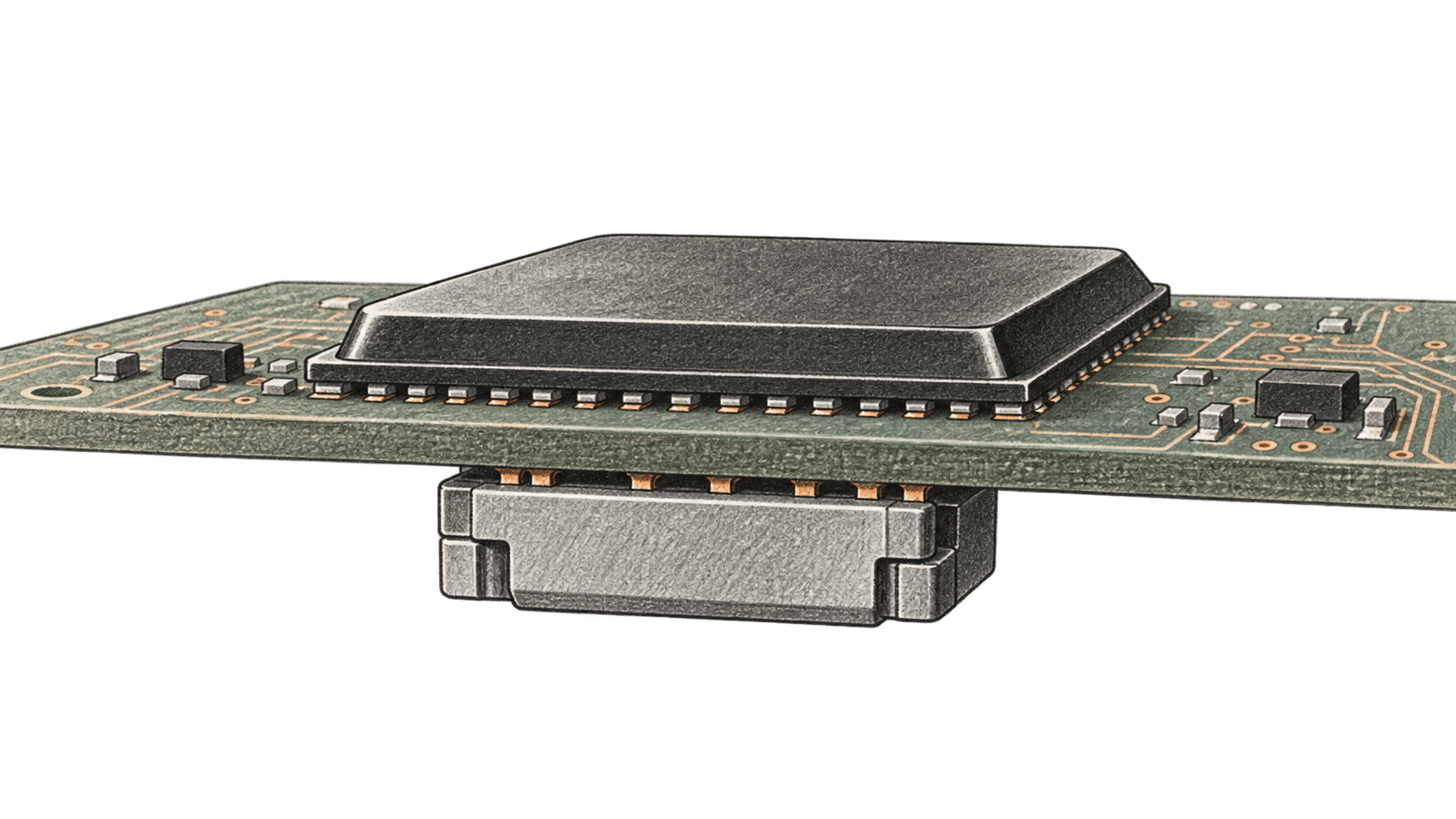
ASE expands PowerSiP for power delivery beneath AI processors

ASE says its PowerSiP expansion lets designers place voltage-regulator modules beneath AI processors. Its claimed 50% or greater reduction concerns parasitic routing losses; the public pages give no test method or system-level measurement.

The big change

What changed: ASE has expanded the packaging options for putting the final voltage-regulation stage beneath an AI processor. That arrangement shortens the board-to-chip route described in its public materials; it does not specify a complete VRM design for every processor.

Why it matters: AI-server designers must deliver high current through limited space around a processor. A shorter route gives power and package engineers another architecture to assess where routing loss and tray thickness constrain the design. ASE's claimed loss reduction concerns that route, while the effect on a complete server remains unmeasured in the public material.

What to watch: A buyer's decision turns on a disclosed test comparison, electrical and mechanical specifications, integration requirements and price. ASE's public release and product page do not supply those details, and its technical brief requires a contact form.

Read the full story
—
Back to the briefing
Original story: guide

How to set Facebook Feed and Reels preferences with Your algorithm

Meta is rolling out topic controls and more detailed post feedback for Facebook Feed and Reels. This documentation-only guide explains the available steps and what remains untested.

The big change

What changed: Facebook is adding an explicit interest input to Feed and Reels ranking. People can manage topics in Your algorithm and, where offered, explain post feedback in their own words. Meta says this supplements the behavioral signals it already uses.

Why it matters: Facebook users can state a preference directly when recommendations miss their interests. The control gives Meta a clearer input, though the company has not shown how reliably it changes an individual feed.

What to watch: Meta has given no account or country timetable for the rollout. Account access is the immediate limit; the longer-term question is whether topic preferences visibly change later recommendations beyond Meta's real-time claim.

Read the full story
—
Back to the briefing