THE WORLD IS NOT STANDING STILL.RSS
BIG CHANGE.
BIG CHANGE, one tap away

Make room for the big picture.

Add BIG CHANGE to your home screen or desktop. It opens in its own window, with the latest stories when you’re online.

iPhone & iPad
Open bigchange.ai in Safari. Tap Share, then Add to Home Screen. Turn on Open as Web App if shown, then tap Add.
Android
Open bigchange.ai in Chrome. In the browser menu, choose Install app or Add to Home screen.
Desktop
In Chrome or Edge, use the install icon in the address bar or the browser’s app menu. In Safari on Mac, choose File → Add to Dock.
All briefings

Follow the change ·

The day,
in perspective.

What happened in AI and robotics — and the change behind it. A reading path through 22 stories from BIG CHANGE.

Ordered using RADAR attention, story opens and likes. Excerpts from our published reporting; open a story for the full context and sources. Dates in UTC.

Original story: analysis

Claude proposes quantum circuits that reduce estimated gate and qubit costs

An Anthropic and Harvard preprint uses Claude to propose quantum circuits and a separate evaluator to check them. Seven of eight tasks show lower estimated gate and qubit counts under the paper's comparisons.

The big change

What changed: An evaluator-guided search produced circuit designs for eight specified quantum-computing primitives. The paper reports lower gate and qubit counts on seven tasks, with a different trade-off for modular inversion.

Why it matters: A large quantum algorithm repeatedly calls smaller routines. Reducing the resources estimated for those routines could lower the requirements of a future implementation, if the designs hold up when integrated with error correction and hardware constraints.

What to watch: Independent scrutiny of the circuit constructions, their stated error budgets and hardware-specific resource estimates will determine how far the results carry beyond these test cases.


Read the full story
—
Back to the briefing
Original story: guide

Review a contract against a playbook with Copilot in Word

Microsoft's legal skill in Word reviews a contract against a .docx playbook, shows extracted rules and proposes tracked edits. A lawyer must check the findings and choose each change.

The big change

What: Microsoft's legal plugin in Word now includes a generally available playbook-based contract review skill for commercial Microsoft 365 Copilot subscribers.

How it works: The user supplies an approved .docx playbook, checks the rules Copilot extracts, runs the review and decides whether to insert each suggested edit as a Word tracked change.

Why it matters: The playbook and contract can be inspected together at the point of editing. Microsoft warns that findings and citations can still be wrong or incomplete, so legal review remains necessary.

Read the full story
—
Back to the briefing
Original story: analysis

How BlenderWorld evaluates editable 3D scenes made by AI agents

QwenLM's BlenderWorld benchmark asks agents to submit native Blender projects. Its task rubrics and visual judges test different aspects of a 3D scene, with limits for real production use.

The big change

What changed: BlenderWorld packages 223 creation requests and 2,651 task-specific binary criteria with a public evaluator for native Blender submissions.

Why it matters: A rendered image can hide a missing object, incorrect dimensions or an unusable project. The benchmark checks requirements with scene inspection and visual evidence, alongside a separate visual-quality score.

What to watch: Independent runs using the published tasks, code and model settings would show how reproducible the authors' scores are. A team's own review of saved projects remains necessary before using them in production.

Read the full story
—
Back to the briefing
Original story: guide

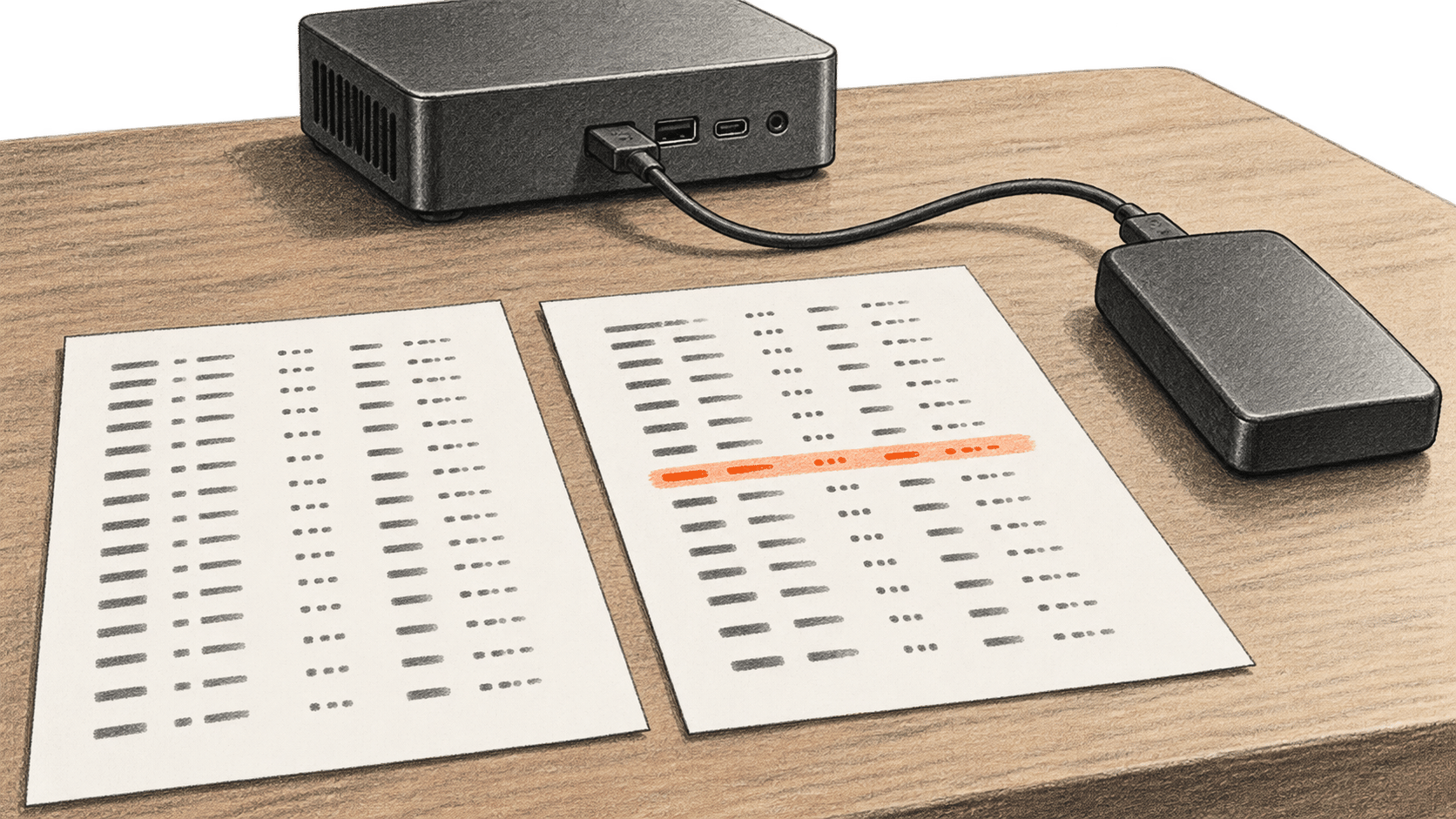
Use paired USB traces to investigate an unsupported Linux device

A documentation-based guide to recording the same hardware operation under a Windows vendor driver and a Linux driver, then testing the differences on real hardware.

The big change

What changed: Schaller has packaged a repeatable way to put a working Windows device session and a Linux driver attempt under the same host-side USB recorder. His scanner result shows why that comparison can help, but it remains a single reported case.

Why it matters: A driver developer can point an AI coding assistant at labeled traces and ask it to propose a protocol explanation or a small probe. The developer still needs the hardware, a working reference operation and direct tests before accepting any generated code.

What to watch: The method depends on whether the relevant device traffic is observable. For an internal MIPI camera, the published harness turns instead to Windows device configuration and ACPI inspection; a USB trace recipe would miss the information the developer needs.

Read the full story
—
Back to the briefing
Original story: guide

How OpenRouter Armor screens tool calls, and when the client must stop them

OpenRouter Armor classifies proposed tool calls against developer rules. Responses and Chat Completions can withhold flagged calls; Messages compatibility leaves the client responsible.

The big change

What changed: An OpenRouter agent can send its proposed tool calls through a classifier that applies developer-written rules before the calls reach the application. A flagged call is skipped in the default enforce path, with a reason returned so the model can continue.

Why it matters: Developers can express action-level limits in prose, including exceptions for narrowly permitted work. The Messages compatibility contract still gives the client the decisive execution step: a client that ignores a flagged verdict can run the call anyway.

What to watch: Teams need to match their client to the chosen API output mode, test rules against their own traffic and decide how classifier errors should behave. The beta's formats may change, and OpenRouter says the classifier can both block acceptable calls and miss unacceptable ones.

Read the full story
—
Back to the briefing
Original story: analysis

Junie Local gives Windows developers a managed local coding agent

JetBrains has made Junie Local stable on supported Windows RTX hardware. Its CLI connects to a local model server, while developers still control repository access, commands and review.

The big change

What changed: Junie Local's Windows path moved from experimental to stable. Its installer checks the hardware and driver, installs the model and CUDA inference engine, and configures Junie CLI to use a local endpoint.

Why it matters: A developer with supported RTX hardware can give Junie a repository task without paying JetBrains per token for this local model. The agent's file and command actions still need review.

What to watch: JetBrains reports up to 55 generated tokens per second in its initial RTX Spark testing. That measures generation speed in the company's setup, not completed coding tasks, correctness or performance on every supported PC.

Read the full story
—
Back to the briefing
Original story: analysis

Apple clarifies App Store rules on nonconsensual intimate imagery

Apple's October 16 update explicitly covers AI-generated intimate imagery without consent, sets out moderation duties and clarifies its existing ban on hidden app features.

The big change

What changed: Apple explicitly places AI content creation apps within its moderation requirements. Developers must account for generated content as well as material users upload or share.

Why it matters: The rules connect safeguards and responses to abuse with the developer's continued access to the App Store. For teams building image tools, moderation is part of the product's eligibility for distribution.

What to watch: Apple leaves the choice of safeguards unspecified. Its decisions about remediation and removal will show which protections it accepts when assessing an app's compliance.

Read the full story
—
Back to the briefing
Original story: guide

Audit one coding-agent session with AgentsView

Find a known local coding-agent transcript in AgentsView, inspect its logged tokens and cost provenance, and read a bounded day report without treating estimates as bills.

The big change

A local transcript gives the cost discussion a traceable starting point. The engineering lead can follow a number back to a specific recorded task and see whether it came from the agent or from a price catalog. Where the log is incomplete, the report should preserve that gap.

Read the full story
—
Back to the briefing