A November 20 preprint introduces Embodied Interaction Policy (EIP), coordinating Astribot S1’s speech and movement during interruptions.
The big change
- What changed: The prototype links listening and speaking with ongoing gestures instead of treating a spoken reply as a finished motion script.
- Why it matters: Gesture research shows that looking natural and matching the spoken message are separate achievements, so an appealing demonstration needs more than one measure.
- What to watch: Motion constraints govern how a robot moves between positions; evaluating its behavior around people requires evidence beyond smooth trajectories.
Listening is a timing problem
The earlier Audio Interaction Model research describes an audio system that repeatedly decides whether to speak or remain silent as sound arrives. That differs from answering only after receiving a complete recording. Continuous interaction requires preserving previous context while processing the next fragment: otherwise a pause, an unfinished request or a new utterance can be interpreted without the conversation that gives it meaning.
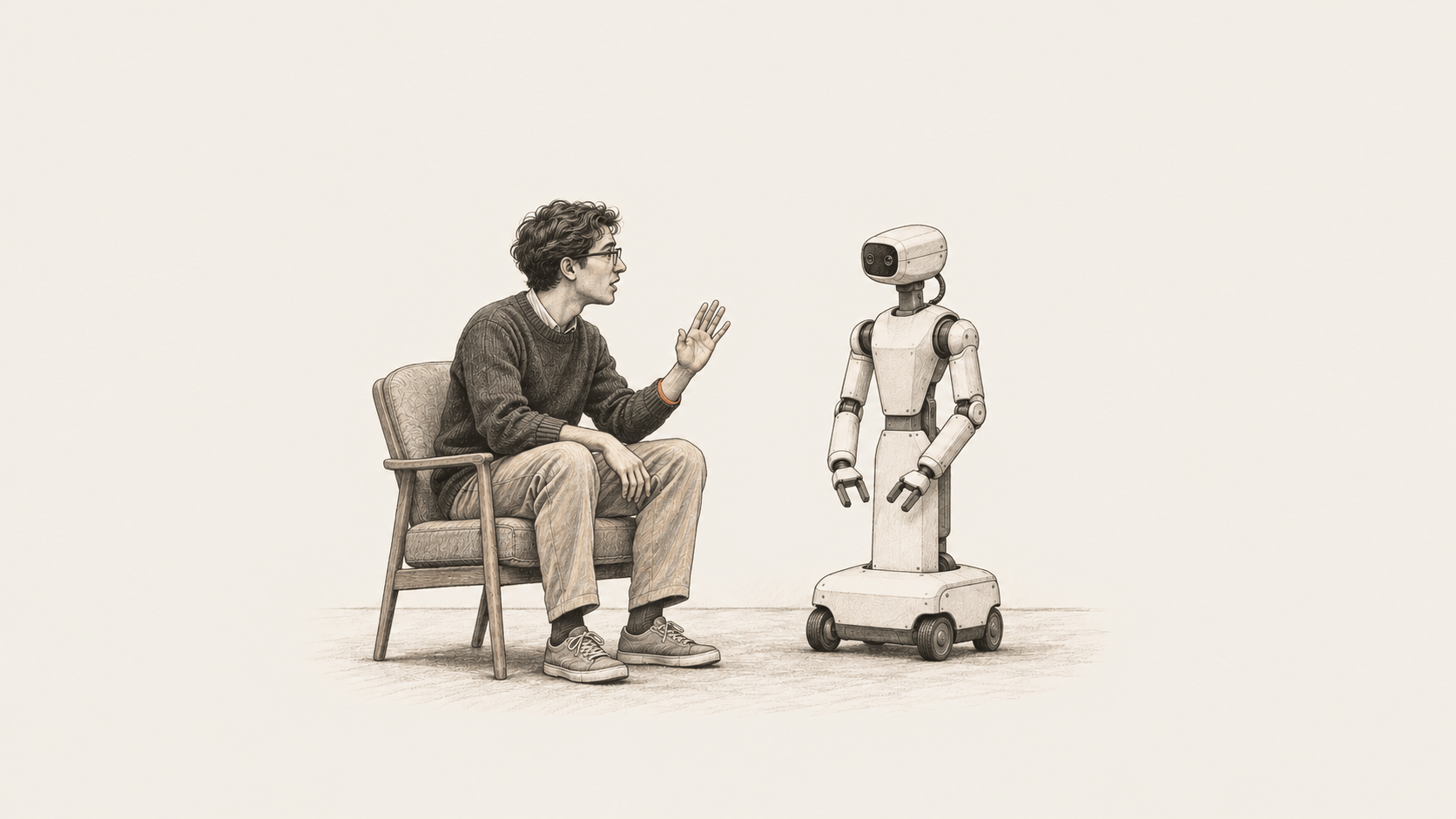
For an illustrative everyday exchange, imagine asking a robot about an exhibition, then interrupting to ask about opening hours. Preparing a fluent answer to the original question is only part of the problem. A conversational system must recognize that the situation has changed and decide whether to yield, rather than simply finish everything it has already prepared. This example explains the timing problem; it is not a recorded trial or a claimed capability score.
EIP couples a frozen audio model with a trained motion model on 400-millisecond chunks. Gestures see only response words whose audio has played, excluding text decoded ahead. Interruptions cancel queued speech and switch motion to listening.
What the measurements establish
The authors report 1.35-second EIP warm-start latency on an RTX A6000: about 64% below RoboGesture's 3.78 seconds and 32% below their 1.99-second cascade. Three scenarios used 20 synthetic speech samples each. Latency measures speech input to first motion execution, not interruption delay.
The original GENEA Challenge evaluation offers a useful reason to separate measurement questions. Teams used shared speech and motion data and a common avatar presentation. Researchers assessed whether movement looked human and, separately, whether it fitted the speech. In the latter test, viewers compared two videos with identical audio: one had matched motion, the other motion from unrelated speech. Keeping the motion source the same helped control for how polished a system looked.
Some synthetic conditions were rated more human-like than the recorded human motion, yet all synthetic conditions were substantially less appropriate for the speech. A pleasing movement can therefore conceal weak correspondence with the message. For a reader assessing a gesture demonstration, the useful questions are whether the body moves convincingly and whether those particular movements belong with those particular words. Neither answer can simply be substituted for the other.
Sixteen video raters and 12 physical-robot participants compared training variants; 15 video raters compared EIP with RoboGesture. The final variant led average video ratings and comfort ratings. Samples were small.
Smooth movement has its own conditions
EIP's execution path also uses collision filtering and Ruckig trajectory generation.
The original Ruckig research addresses movement from a current position, velocity and acceleration to a target state, subject to limits. Velocity describes how quickly position changes. Acceleration describes how quickly velocity changes; jerk describes changes in acceleration. Limiting jerk helps avoid an abrupt change in how a machine speeds up or slows down, rather than merely placing a ceiling on its top speed.
This distinction matters when a motion target changes before the previous movement finishes. A trajectory generator must account for the state the machine has actually reached, rather than assume it is stationary at the start of every instruction. Ruckig's stated guarantee concerns trajectories under its kinematic constraints. That problem formulation does not by itself establish collision avoidance, appropriate conversational judgment or safety in every setting. Smoothness is one engineering requirement for physical interaction, and it needs to remain distinguishable from the wider decision about where a robot can be used.
BIG CHANGE reviewed the papers and reported protocols; it did not operate the prototype or independently reproduce the experiments.