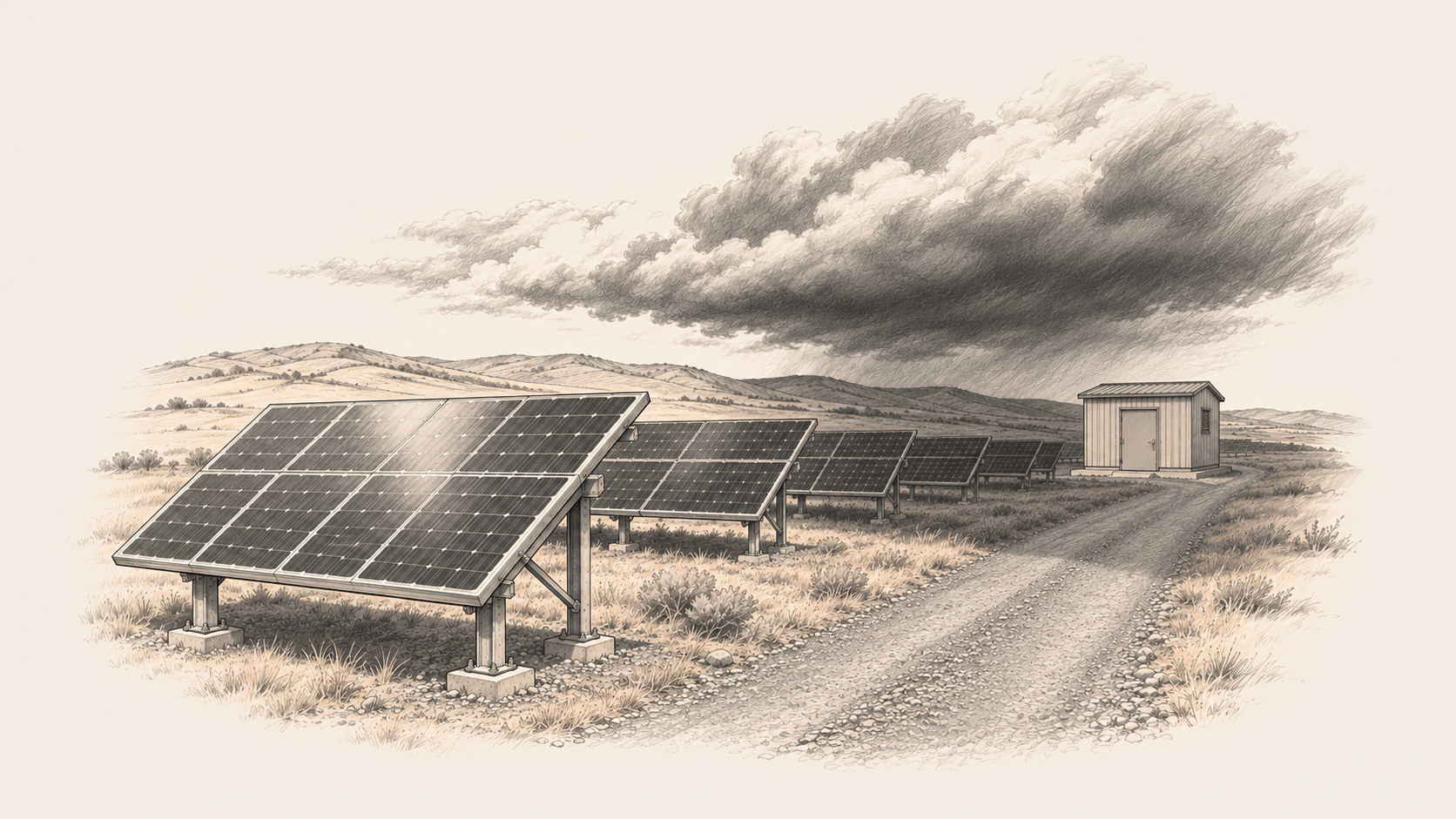
On November 24, TechCrunch interviewed G2 partner Brook Porter about AI power. The firm's November analysis proposes solar and long-duration storage for large campuses, with flexible grid connections for smaller sites.
The big change
- G2 advocates off-grid solar with thermal storage for gigawatt-scale sites. Its cost and delivery claims describe a proposed path, rather than an operating campus independently shown to meet those conditions.
- A power rating and an energy reserve measure different things. EIA's storage definitions explain why a system needs enough output for the load and enough stored energy to sustain that output over time.
- Berkeley Lab's queue research documents proposed power plants and storage seeking transmission connections. Its completion times help explain infrastructure constraints, but they are not a timetable for connecting an individual AI campus.
What the investor's proposal establishes
G2 estimates firm power at about $0.10 per kilowatt-hour, falling toward $0.05 at terawatt scale. The cost case assumes thermal storage; the proposed duration is 50–100 hours. Firm supply is intended to be available when required.
Its lithium-ion cost chart is a different calculation. The presentation labels its 99.999% ‘uptime’ point an extrapolation beyond Ember's 99.4% sizing. A curve extending an earlier model is not measured campus uptime.
G2's own portfolio lists Crusoe and Antora. That commercial exposure matters when reading its advocacy; portfolio membership does not establish that a company has committed a campus to the proposed design.
What the weather model actually assumes
Ember's June 2025 study models solar and batteries against a constant 1-gigawatt target. Its Las Vegas example pairs 6 gigawatts of solar with 17 gigawatt-hours of batteries. These describe equipment sizing in a simulation, not a field trial.
The methods use fixed-tilt panels and hourly solar data from the European Commission's PVGIS tool. The hourly dispatch description uses 2023; the study also examines variation across 2005–2023. The battery starts fully charged, operates between 5% and 95% charge, and receives no grid electricity. The assumed solar-to-battery-to-output efficiency is 94.4%.
Cloudy stretches can exhaust the available store and leave demand unmet. An average-day balance therefore does not establish uninterrupted service through adverse weather. Its financial assumptions include 2024 capital costs, a 20-year life and a 7.7% discount rate. Changing those inputs changes the economic comparison.
A gigawatt is not a gigawatt-hour
The US Energy Information Administration distinguishes power capacity, measured in megawatts, from energy capacity, measured in megawatt-hours. The first is a rate of output; the second is an amount available to discharge.
For an illustrative constant load, 1 gigawatt sustained for 24 hours requires 24 gigawatt-hours of delivered electricity. That arithmetic comes before charging losses or a reserve margin.
EIA defines storage duration as energy capacity divided by power capacity. A large energy store can still have an insufficient discharge rate; a high power rating can still run out quickly.
Batteries consume electricity as well as supply it, and charging must cover cycle losses. A duration rating consequently says what a charged store can deliver under specified conditions. It does not establish that enough energy will be available to refill it.
Stored heat needs a route back to electricity
Antora's technology page describes resistive heating of solid carbon blocks, followed by multi-day storage. The company says the heat can serve industrial processes or be paired with steam-turbine equipment to deliver power.
The same page places integrated thermophotovoltaic conversion in future products. That method converts light emitted by hot carbon into electricity. It should not be conflated with the currently described route through separate turbine equipment.
These are provider descriptions, not independent results for a gigawatt-scale AI facility. They make an important distinction visible: a medium that stores heat and equipment that returns electricity perform different jobs. An electrical buyer needs evidence for the complete conversion path, rather than treating the amount of stored heat as electricity already available at a rack.
Connection queues measure a different project
Berkeley Lab's 2026 edition uses records through the end of 2025. The data covers all seven US independent grid operators and 50 other utilities, representing about 98% of installed generating capacity.
For regions with available data, power projects completed in 2025 took a median of more than five years from interconnection request to commercial operation. The study also records 549 gigawatts with draft or executed connection agreements that had not begun commercial operation.
Those observations distinguish an application, an agreement and an operating asset. The dataset concerns generation and storage joining transmission networks; it does not directly measure a data center's wait for an electricity supply connection.
For a developer, the practical evidence is therefore specific: what the network operator has agreed, what plant is actually commissioned, and what electricity can be delivered under the site's conditions.