On November 20, 2026, METR published harder tests and a combined capability index for public AI models.
The big change
- METR says its older TH1.1 task suite is saturated: high scores no longer distinguish models well. The new report therefore adds harder tests.
- A time horizon uses the time a human expert needs for a task. A 50% horizon is the human duration where a fitted curve predicts 50% success. It is not the model’s running time.
- A combined index can compare results from tests of different difficulty. Epoch AI’s separate methodology explains why scores near a test’s ceiling carry little information about further improvement, while also exposing assumptions and uncertainty.
What changed in the new assessment
METR pairs scores for 34 of its 36 new tasks with the time an expert would need to reach them. Three tasks use successful human attempts; 31 use researcher estimates. Participants could use Sonnet 5 for implementation.
The new TH2 suite includes automatically checked optimization, machine-learning, puzzle and game tasks, such as improving a language-model training script. Its hard-to-verify research and judgment tasks include designing an informative evaluation or rating critiques of philosophical arguments against expert judgments. These require judgment where quick, clear feedback is unavailable.
METR reports strong coding and optimization but weaker judgment without clear feedback. These tests measure public-model capability, not a lab’s observed productivity or deployed safety.
What a horizon does and does not promise
METR’s original time-horizon paper grounded its measure in a defined set of software tasks. People with relevant expertise attempted tasks, and the researchers used successful human completion times to estimate difficulty. They then fitted model success against those durations.
That turns the comparison into an interpretable question: how often does an agent complete work that takes the reference human a given amount of time? Changing the success threshold changes the answer. A 50% horizon is a different reliability requirement from an 80% horizon.
The paper also warns about external validity: results on self-contained tasks may not transfer to work with more context, ambiguity or hidden requirements.
Why a ceiling can hide improvement
Epoch’s ECI methodology jointly estimates model capability, benchmark difficulty and how sharply a test separates nearby capabilities. When models sit far above a test’s difficulty, their expected scores cluster near the top. The test then distinguishes them poorly.
Combining harder and easier tests can preserve information after one test saturates. Epoch uses overlapping model results to connect benchmarks on a common scale; the scale’s absolute values are not meaningful by themselves.
Its published scores include uncertainty intervals, and values can move when the combined dataset is refitted. Epoch’s scale describes its own combined dataset, not a universal unit of intelligence.
What a clear scoring rule looks like
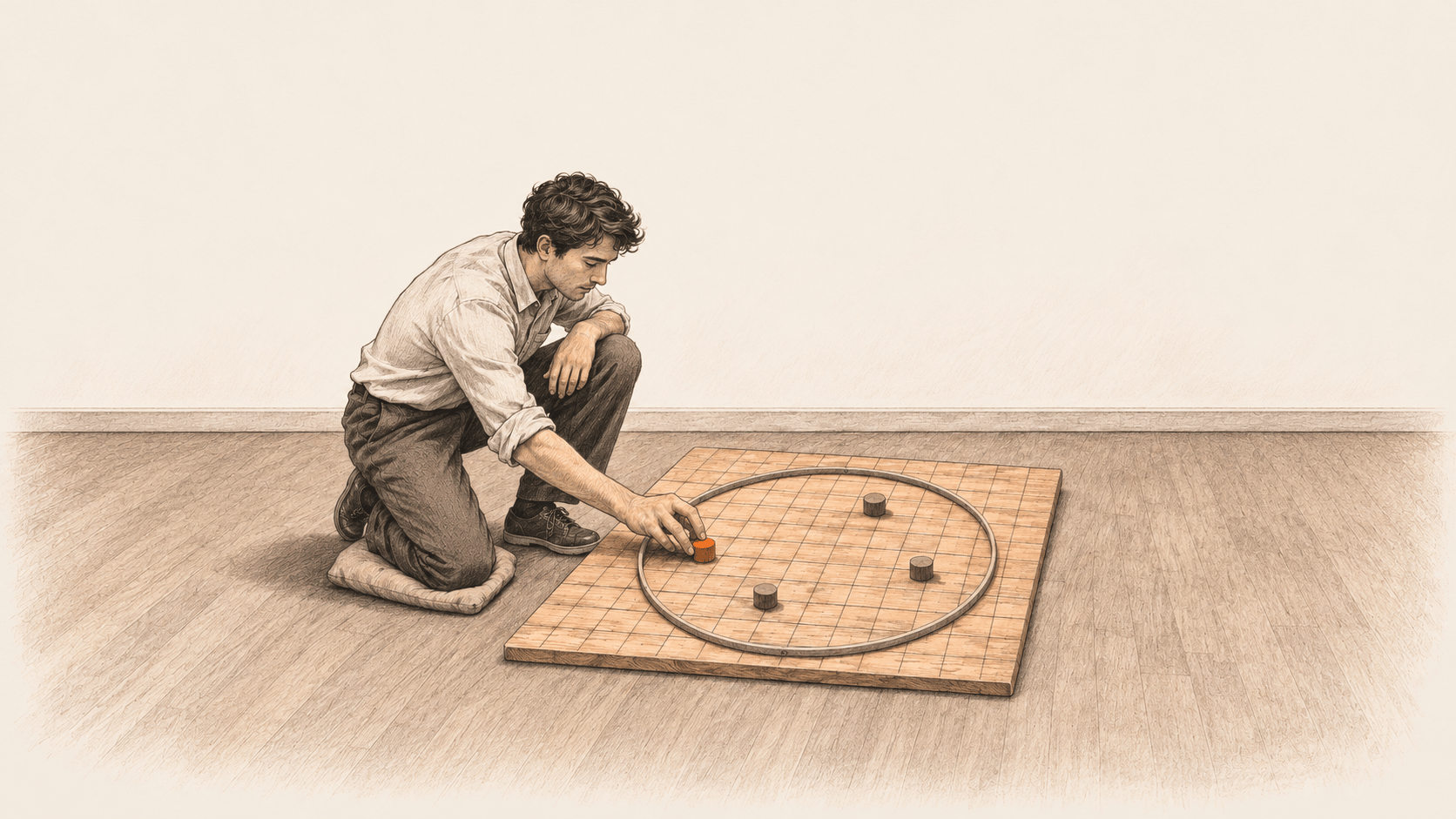
Separately, Al Zimmermann’s Point Packing contest provides a concrete example of an explicit objective. Entrants place points at nonnegative integer coordinates, with every pairwise distance distinct. A smaller enclosing circle is better. The rules distinguish an invalid arrangement from a valid one that simply packs less tightly.
The organizer takes submitted solutions, rather than requiring a particular program, and describes immediate feedback. That gives a solver a defined target against which to compare revisions. It does not judge whether the solver chose a useful research question or whether a solution will generalize beyond those rules.
For a team choosing an agent, a test score differs from success on its own work. A harder benchmark can reveal differences hidden by a ceiling; it still needs a task population, a reference standard and evidence that the comparison fits the decision.