Japan's push into physical AI now includes a working humanoid data facility and a large public program to develop a domestic foundation model. They address related needs, but the available records do not show that the facility receives the model program's budget or supplies its training data.
An October 5 report from Jiji Press grouped the projects in a wider account of Japanese companies joining forces around robotics. The clearest way to read that activity is to follow what each project is set up to produce. One gathers and prepares records of robot work; the other funds research toward a model that could handle several kinds of information.
The big change
- What changed: J-HRTI's August opening gives member companies a place to produce and share humanoid training data while keeping work in a secure area proprietary. A separate national program selected Noetra and AIST to develop a domestic multimodal model.
- Why it matters: Manufacturers considering J-HRTI can divide data-collection costs and test their own tasks while retaining private work. The national program funds model research; its budget does not establish that J-HRTI receives a grant or that either effort has delivered autonomous factory work.
- What to watch: J-HRTI's membership terms, published task results and industrial deployments will show the facility's practical reach. Any claimed connection to Noetra's model would need a documented data or research agreement, which the reviewed sources do not provide.
What happens at the Kanto Data Factory
The J-HRTI consortium says its Kanto Data Factory began full operation on August 26, 2026, in Narashino, Chiba Prefecture. Its opening notice lists 35 humanoid robots at the start and room for up to 40. Those are a reported opening count and a capacity figure, respectively, not a count of robots deployed in customers' workplaces.
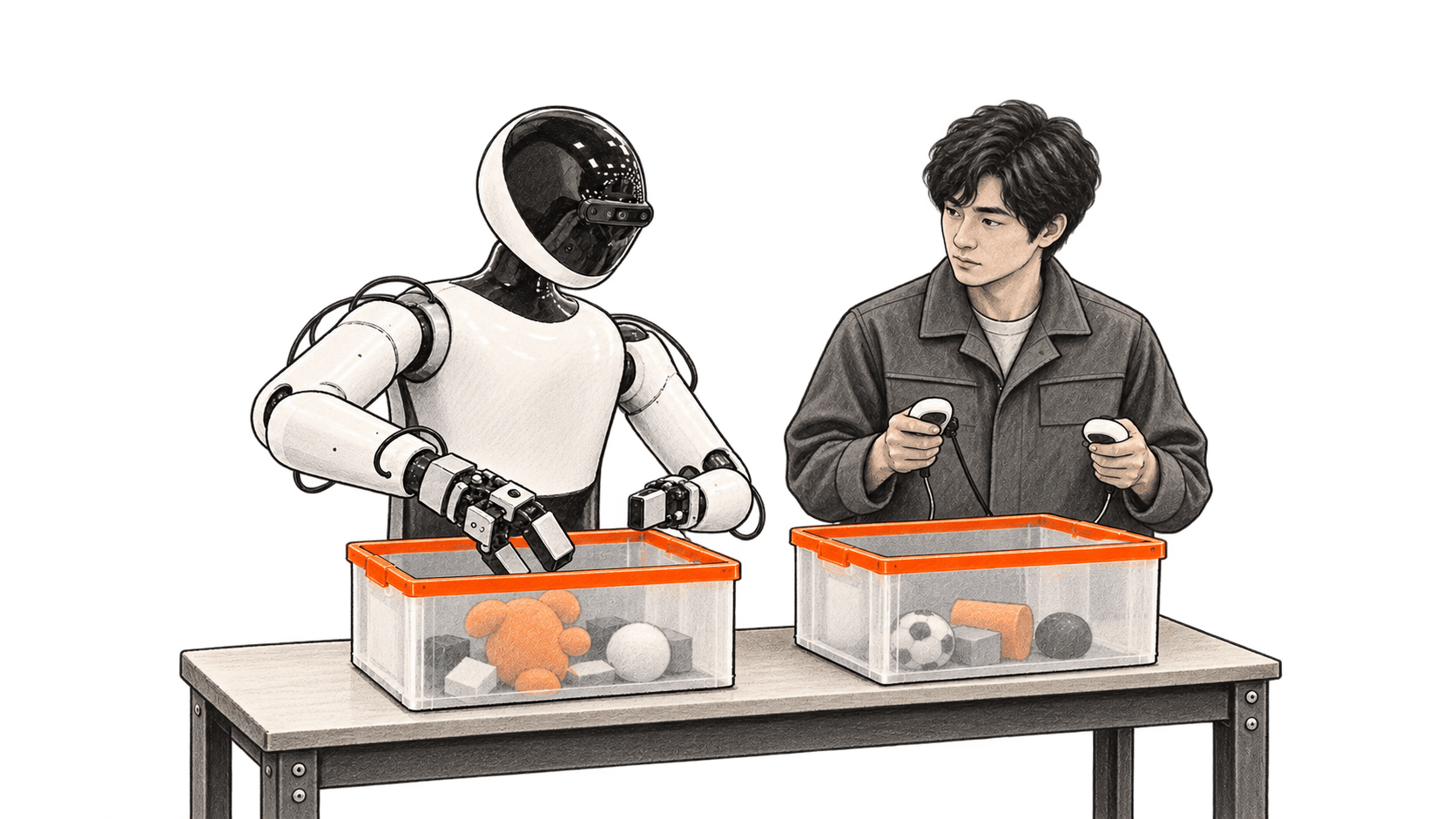
The opening notices describe a robot area, an annotation area and a test area. J-HRTI's current facility page calls them training, annotation and secure areas, and explains a consequential boundary between shared and private work. Operators control robots in settings built to resemble workplaces, generating demonstrations for imitation learning. Staff then label whether actions succeeded or failed, turning the records into training data. In the secure area, a member can reproduce its own workplace for final adjustments; J-HRTI says neither the work nor the data collected there is shared with other members. A Yamazen release distributed through Kyodo PR Wire adds that staff prepare motion video and joint data.
The operator supplies an example action, annotation attaches the outcome, and workplace-specific tests can expose where adjustment is needed. J-HRTI says six member companies, as of August 2026, divide costs and share some training data and results. The secure-area exception matters to a manufacturer weighing collaboration against protection of its own processes. J-HRTI's plan to expand to ten sites and deploy humanoids in industry remains a plan. The cited material gives no measured task success rate, production throughput, safety record or evidence that a participating factory has achieved autonomous operation.
For a manufacturer considering the facility, J-HRTI publishes a participation route: an initial briefing, a nondisclosure agreement before a visit, a site visit and meeting, then a contract for formal membership. Visits are limited to companies considering participation. The facility page describes shared training data and a private secure area, but gives no participant fee amount, dataset specifications, data API terms or benchmark results.
What the national model budget covers
Japan's Ministry of Economy, Trade and Industry (METI) describes a separate FY2026 budget proposal of ¥387.3 billion for developing a domestic multimodal foundation model for AI robots and physical AI. The budget sheet labels the amount as a new program line and shows money moving from the government to NEDO, then through commissioned work to companies and other organizations. It is a program amount, not an award to J-HRTI or a price tag for the Kanto facility.
On June 30, 2026, METI announced that NEDO had selected Noetra and the National Institute of Advanced Industrial Science and Technology (AIST) for the 2026–2030 program. METI says Noetra is to develop and provide a multimodal foundation model, while AIST is to work on advanced research with other institutions. METI defines the intended model as one that can handle language, audio, images, video and sensor data. Selection and budget allocation establish the start and intended scope of research; they do not establish a completed model or its performance in industrial robots.
Sources & further reading
- J-HRTI, Kanto Data Factory opening notice (August 26, 2026). The operator's account of the opening robot count, capacity, facility areas and expansion plan; operational claims are self-reported.
- J-HRTI, Kanto Data Factory facility page (checked October 6, 2026). The operator's description of training and annotation, shared member data, the private secure area and the route from briefing to membership. No participation price or data API terms are listed.
- Yamazen release via Kyodo PR Wire (August 26, 2026). Participant description of motion-video and joint-data preparation, test areas and intended sharing. This is a company release, not an independent test.
- METI, multimodal foundation-model program announcement (June 30, 2026). Official selection of Noetra and AIST and description of their planned roles.
- METI, FY2026 GX budget program sheet (FY2026 proposal). The ¥387.3 billion program line, funding route and stated goals; the figure is not a J-HRTI facility grant.
- Jiji Press report carried by TheNews (October 5, 2026). Current roundup context for Japan's physical-AI partnerships; its future effects remain predictions.