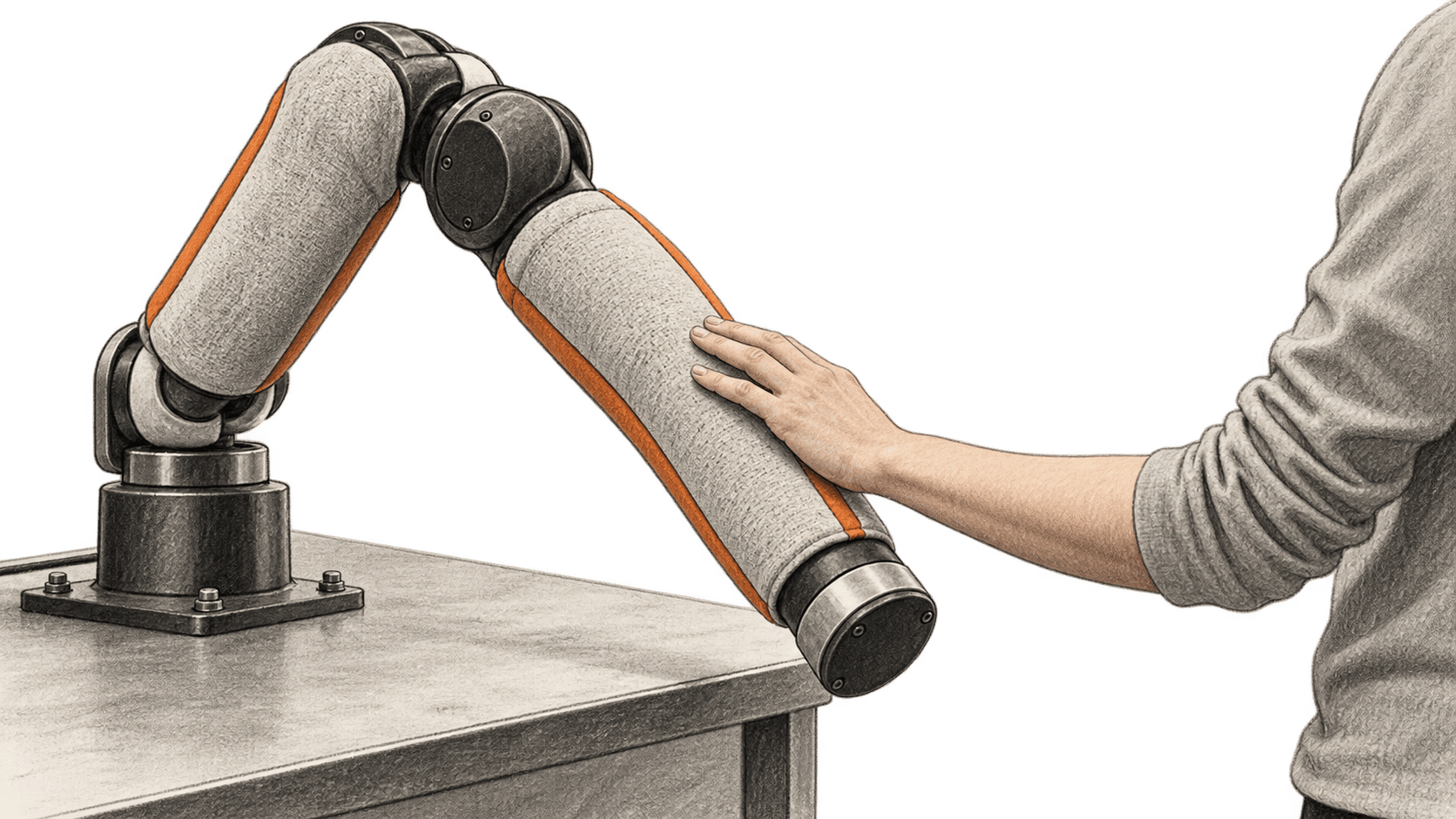
Researchers at the Hong Kong University of Science and Technology have built a robotic arm that senses contact along its upper arm and forearm, then uses that information to adjust its movement. Their EmArm system combines a soft optical tactile skin, joint-position sensing and a control loop. In lab demonstrations, the arm responded to touch, steadied an off-center basketball and stopped and replanned a path after contact with an obstacle.
HKUST described the work on October 16. The peer-reviewed paper appeared in Nature Sensors on July 20. This is research on a prototype, with the new university account drawing attention to earlier published experiments. It does not document a robot deployed in homes, factories or clinics.
The big change
- What changed: EmArm places tactile sensing across much of a rigid arm and feeds contact features together with joint angles into its movement decisions. The researchers report demonstrations of touch classification, object balancing and path replanning when an obstacle is outside the robot's view.
- Why it matters: Contact can happen anywhere along an arm, including beyond a gripper. Sensing where and how the arm is touched gives the controller information that vision or a few force sensors may miss in the demonstrated tasks.
- What to watch: The published evidence concerns a research platform and bounded experiments. Repeated tests in less controlled settings, independent reproduction and practical access to the implementation would be needed to assess broader use.
From contact to a movement change
EmArm's upper arm and forearm carry more than 71,000 square millimeters of soft optical skin, according to HKUST. Cameras inside the arm read how the skin changes under contact. The system combines that signal with joint-angle data and extracts features such as contact position, area and force. Its control loop uses those features to decide how the arm should move. The paper describes this as a combination of rigid mechanics, soft tactile sensing, proprioception and perception-driven action.
In related work, Boston Dynamics' Atlas hand puts pressure sensors in its palm and fingertips for manipulation. EmArm investigates contact across the upper arm and forearm. These are separate robot systems and research efforts.
This arrangement matters in the basketball demonstration. HKUST says the controller compares current tactile features with a previously learned policy, generates joint-angle commands and adjusts force as it holds a ball placed off-center. The published description establishes a specific control task; it does not show that the arm can handle arbitrary objects or settings.
In another experiment, an obstacle that the visual system could not see entered the arm's path. HKUST reports that touch triggered a stop, an assessment of whether the obstacle persisted and a revised path. That sequence illustrates what whole-arm contact information can add to motion control. The experiment does not establish a general safety rating for work beside people.
What the experiments measured
The authors report submillimeter tactile localization in the paper's abstract. HKUST gives a spatial-resolution figure of 0.085 millimeters, an 18.2-millimeter two-point discrimination threshold and sensing fidelity of up to 97.9% under five tested forms of environmental disturbance. Those are measurements of this platform under the team's conditions, rather than a measure of reliable operation across unfamiliar workplaces.
The university also reports up to 99.8% accuracy for distinguishing five tested kinds of human touch: stroking, pinching, poking, tickling and hitting. The system mapped these interactions to five preset facial expressions. That result is a classification of touches in a defined experiment; it is not evidence that the arm detected a person's emotions or intent in general.
The AI contribution is in interpreting the tactile and joint signals and turning them into decisions in the demonstrated tasks. HKUST describes real-time feature extraction and a previously learned control policy for the ball task. The publicly accessible paper abstract does not specify a general-purpose AI model or support a claim that EmArm can learn any manipulation task. We reviewed the paper and university explanation, but did not build or test the arm or reproduce the reported measurements.
Reproduction and practical limits
The paper makes its human-interaction dataset available through figshare and supplies supplementary material and figure data. It says the supporting code is available from the corresponding author on request. The full paper is subscription content. We found no published product access path or system price in those primary materials. A downloadable dataset alone is insufficient to reproduce the hardware, sensing and control experiments.
The team's proposed future applications include service, industrial and medical-assistance robots. Those are possible directions, not measured deployments. The immediate result is narrower and useful: the researchers demonstrated a way to connect distributed arm contact to motion decisions, with open questions about robustness, repeatability and access outside their lab.
Sources & further reading
- Tang and colleagues, Nature Sensors, published July 20, 2026. Peer-reviewed description of EmArm's sensing and control framework, demonstration categories, data and code availability. The accessible article page is an abstract and metadata preview; the full paper requires access.
- HKUST School of Engineering account, October 16, 2026. Research team's explanation and reported measurements and demonstrations. Its application outlook is a proposal from the researchers.
- Human-interaction dataset on figshare, posted July 21, 2026. Dataset linked by the paper; availability of these records does not reproduce the arm.