In a virtual workplace study, 189 knowledge workers gave different ratings and monetary rewards to AI assistants that shared the same underlying language model. The University of Zurich researchers' October 14 account reports that humanlike avatars received more trust, credit and money than a desk robot. One avatar, Johan, also received more money than Johanna, but the researchers caution that gender alone cannot explain that difference.
The result concerns a controlled virtual reality task. Participants allocated up to four Swiss francs after each collaboration, keeping the rest. It does not measure wages paid to people, AI pricing or the effects of deploying avatars across a workplace.
The big change
- What changed: A study held the assistant's language model and interaction pipeline constant while changing how participants encountered it. Its specific humanlike avatars received higher ratings and rewards than its desk robot.
- Why it matters: The presentation of an AI assistant can affect how people judge and reward its contribution, even when the system behind it is the same. A designer cannot assume that the most positively rated form is the one workers prefer.
- What to watch: Studies with more systematically varied avatars and longer use could separate gender cues, perceived human likeness and other design features. This experiment does not establish how those factors would play out in ordinary work.
The same assistant in different forms
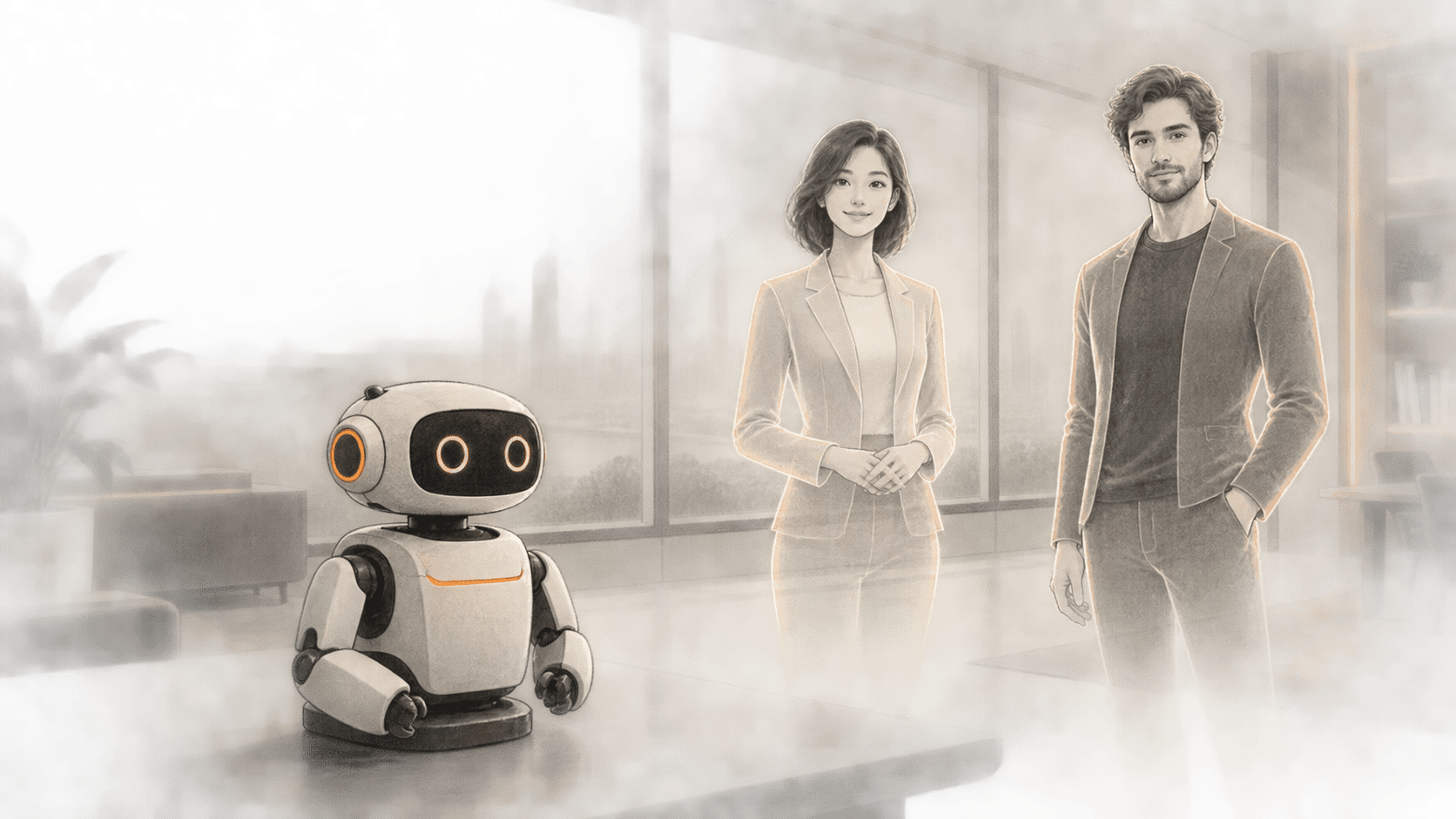
Participants brainstormed workplace topics in three rounds: a text chat, a desk robot, and either Johan or Johanna, two humanlike virtual assistants with male and female presentation. The researchers say all four representations used the same large language model and interaction pipeline. After each round, participants rated human likeness, trust and credit, then could allocate part of a four franc reward to the assistant. The team also interviewed 34 participants.
The authors' report says the two humanlike avatars were rated more humanlike, trusted more, credited more and rewarded more than the desk robot. Those differences were statistically significant in the reported comparison. Interviewees sometimes described the avatars as more personable or colleague like, and some connected that impression to their ratings or rewards. Yet the interviews found no clear preference for a humanlike assistant. Many participants said they would rather use one that was visibly nonhuman.
That divergence is useful for people designing workplace AI. A rating collected immediately after a task and a stated preference for future use answer different questions. The study shows they need not move together for these particular designs. It does not identify a universally preferred appearance for AI assistants.
What the Johan and Johanna result can say
Each participant met only one of the two humanlike avatars, so the comparison between Johan and Johanna was between participants. Johan was rated more humanlike and received a higher monetary allocation. The authors report no statistically significant difference between the two avatars in trust or credit ratings.
Many interviewees said an assistant's gender should not affect their judgments, and many preferred a genderless assistant. That stated view sits beside the measured reward difference, but it does not prove why participants allocated money differently. As the researchers explain, the study used one male presenting and one female presenting avatar. The pair also differed in perceived human likeness, and other features of the specific designs may have contributed. Testing multiple avatars while varying those cues independently would be needed to attribute an effect to gender.
The publicly accessible paper record identifies the 2026 conference study and DOI. BIG CHANGE could not access the full paper through ACM or the university repository, so this account relies on the authors' published explanation rather than a fresh review of its statistical tables. BIG CHANGE could not independently verify the reward amounts or effect sizes from the full paper.
Earlier BIG CHANGE coverage of a gender bias audit examined differences in AI models' answers. This experiment concerns people's responses to representations of one underlying assistant. The two studies address related bias questions through different outcomes.
Sources & further reading
- Human-Like and Male? How AI Assistant Design Relates to Trust and Monetary Reward at Work in VR. Isabelle Cuber for the University of Zurich Human Aspects of Software Engineering Lab, October 14, 2026. The researchers describe the study setup, reported comparisons, interviews and limits. The prose account does not provide numerical effect sizes or full statistical tables.
- Publication record for the study. University of Limerick, 2026. Confirms the paper's authors, conference publication and DOI 10.1145/3829807.3829910, and provides its abstract. The full paper was not accessible for independent methods or table review.
- Ten AI models gave sharply different answers in a gender bias audit. BIG CHANGE, October 2, 2026. Related coverage of model output behavior, distinct from this study of participant evaluations and rewards.