Yaskawa's orders reached a quarterly high in the three months to August 31, yet its robotics business earned less over the first half of its financial year. In its October 9 results briefing, the Japanese automation company reported second-quarter orders up 38% from a year earlier and 13% from the preceding quarter. It attributed the increase mainly to investment related to data centers and semiconductors.
The figures give two different views of demand. Yaskawa sells equipment into industries expanding AI computing capacity, while it is also developing robots that use AI to handle less predictable work. The company did not disclose how many AI robots it sold or how much of the order increase came from them.
The big change
- What changed: Second-quarter orders rose to a company record, according to Yaskawa, while first-half revenue grew 9.8% year over year. First-half operating profit fell 5.5%, and operating profit in the robotics segment fell 43.3%.
- Why it matters: The strongest reported growth came from motion-control products used in equipment for data centers, semiconductors and other markets. That demand has a different financial profile from Yaskawa's work to expand AI-enabled robotics.
- What remains unknown: The presentation does not break out AI-robot sales, deployment performance or customer savings. Its named automation examples show the tasks Yaskawa is pursuing, not a measured return across factories.
Demand for components outpaced robotics revenue
Yaskawa's segment table puts first-half motion-control revenue 21.7% above the same period last year. The company says sales of AC servos and controllers grew mainly with semiconductor, electronic-component and machine-tool demand. Sales of drives also expanded for data-center applications, semiconductor manufacturing equipment, and oil and gas. It separately reports US orders for U1000 drives used in data-center cooling systems.
Robotics moved differently. The segment's first-half revenue fell 0.7%, while operating profit fell 43.3% and its operating margin narrowed from 8.8% to 5.0%. Yaskawa attributes lower robotics profit to lower revenue and temporary European restructuring costs. It reports expanded overseas sales, with automotive sales holding firm in the Americas and semiconductor-robot sales strong in China; Japanese sales were affected by its new enterprise-system rollout.
The presentation's quarterly chart also reports robotics orders up 33% year over year in the second quarter. That incoming business has yet to appear as a comparable increase in first-half robotics sales or profit. Orders, recognized sales and operating profit cover different periods and products, and Yaskawa gives no AI-specific split for any of them.
The robot work behind the physical AI label
In the same briefing, Yaskawa says it is developing and validating physical-AI systems with partners around its MOTOMAN NEXT line. The company reports that its fifth robot factory in Kitakyushu began full operation and uses MOTOMAN NEXT in production. It lists two customer-related tasks: a mixed-case palletizing system developed with Seibu Electric & Machinery, and automation of sauce dispensing on food products with NIPPN.
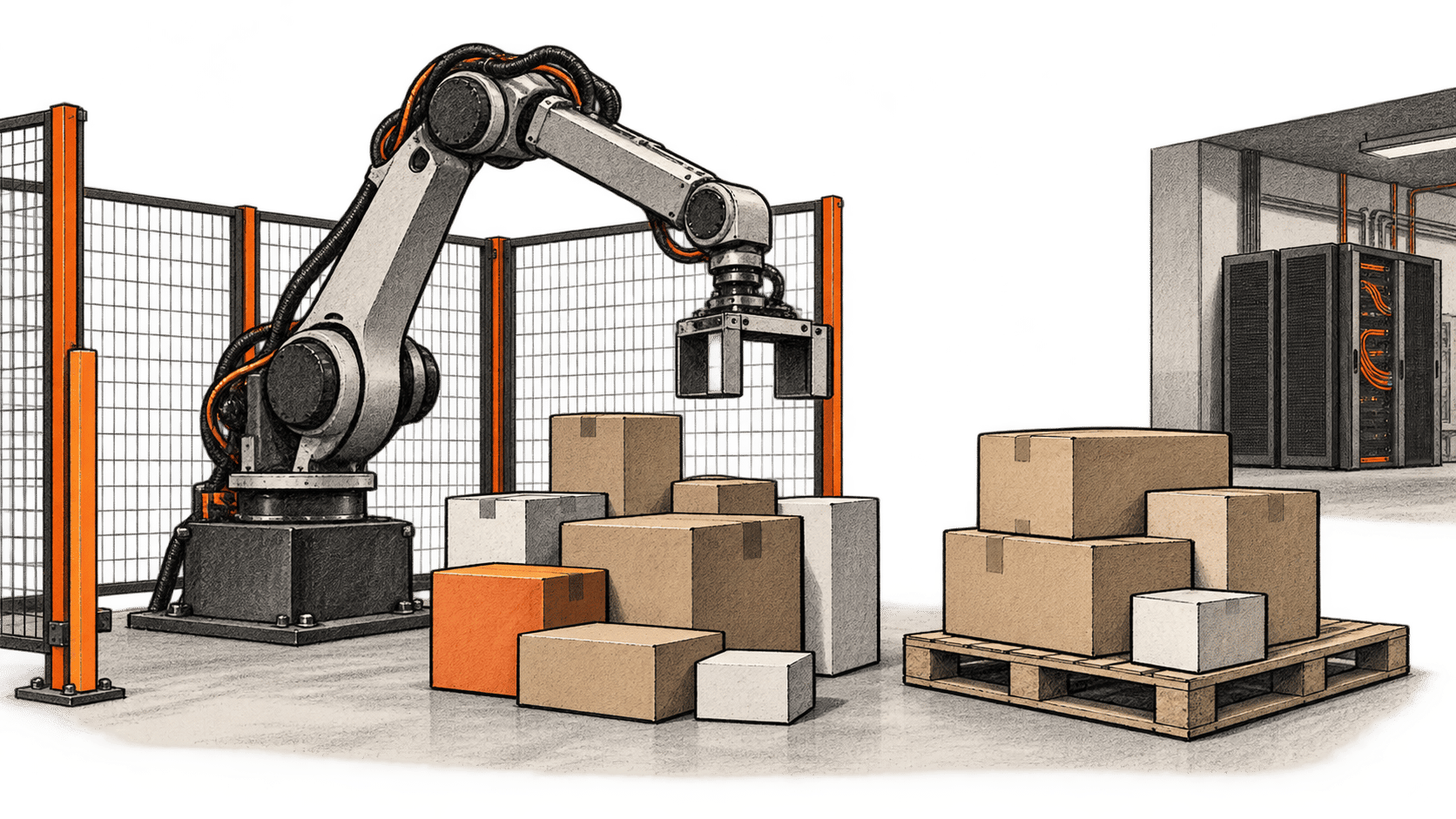
The palletizing description is explicitly a development aim: use AI to choose loading patterns for boxes of irregular sizes on delivery containers. The food example says AI compares a product sample with the item being made, then chooses a sauce-dispensing action; Yaskawa describes reduced changeover work and steadier quality. Neither example supplies throughput, error-rate or cost figures in the briefing. Its technical MOTOMAN NEXT report from June describes an onboard autonomous-control unit for sensing changes, planning motion and executing actions, but that company account does not measure the October examples independently.
The October accounts document current component demand and the economics of an established robotics segment. The task descriptions show where Yaskawa is trying to extend robot capability. A buyer evaluating either system still needs task-specific production data and integration requirements, which the briefing does not provide.
Sources & further reading
- Yaskawa's English first-half FY2026 results briefing, October 9, 2026. Pages 1, 5–8 and 14–15 support the order, revenue, segment and robot-task details. These are company-reported figures and descriptions.
- Yaskawa's Japanese results briefing and IR listing. The original-language record and publication date.
- Yaskawa's June 23 MOTOMAN NEXT technical report. It describes the company's robot-control approach; it is not an independent test of the examples in the October briefing.